
You might think that the fight against poverty would involve considerable resources, a mix of various social and economic policies and a lot of political will. Sure, you could do it that way but it’s a lot of work. Why not just reduce poverty statistically? Hundreds of thousands can be taken out of poverty with the stroke of an excel sheet – and all without breaking a sweat.
Every once in a while a Government spokesperson or some commentator will point out that Ireland’s at-risk-of poverty rate has remamined steady during the recession and compares quite favourably with European averages.
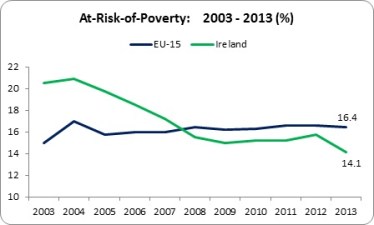
And on a surface reading it looks true. Irish at-risk-of-poverty rates were falling prior to 2008 and continued falling over the course of the recession. Irish rates are below that of EU-15 rates.
Yet, CSO and Eurostat data show deprivation rates in Ireland to have nearly doubled since the recession started. So how can we square rising deprivation with falling at-risk-of-poverty?
Deprivation rates are a subjective measurement; that is, people are asked whether they have suffered any or all of a list of deprivation experiences. In this respect, it cannot be independently or objectively measured. This doesn’t make it any less reliable or instructive.
At-risk-of-poverty, however, is a relative measurement. It doesn’t survey the actual living conditions of people. It makes an assumption: people are at-risk-of-poverty if they have income which is 60 percent or less than the national median income (median income is that point at which 50 percent earn above and 50 percent earn below). In other words, it is relative to the median. And this is where the problem starts.
In normal times, when there is stable economic growth and stable income rises, the relative measurement is fairly straight-forward and uncontentious. However, we can get perverse readings during abnormal times of falling growth and incomes.
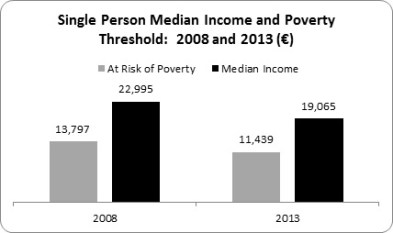
The median income has fallen by 17.1 percent since 2008. Therefore, the poverty threshold has fallen (since it is relative to the median income). Let’s see what perversity this creates.
- In 2008, your income was €13,500. This was below the poverty threshold. Therefore, you are at-risk-of-poverty. That is, you are poor.
- By 2013, your income actually fell to €11,500. It fell by €2,000, or nearly 15 percent. However, your income is now above the poverty threshold. Therefore, you are not at risk-of-poverty. That is, you are not poor.
So, you’re poor in 2008. Your income falls. But now you are not considered poor. Why? Because national incomes fell faster than your income.
Ireland was the only country in the EU-15 (bar poor Greece) to experience a fall in median incomes and, so, the poverty threshold. For single persons, median incomes in the EU-15 increased by 7 percent; in Ireland it fell by 17 percent.
So to say that Ireland has not experienced an increase of poverty since the crash is technically correct but amounts to a statistical three-card trick.
Fortunately, there is another at-risk-of-poverty measurement that can give us a better insight. This involves ‘anchoring’ thresholds to remove the perversity outlined above:
‘To allow for these sudden fluctuations in poverty thresholds and in order to avoid misleading results in periods of rapid and general economic deterioration, Eurostat calculates the at-risk-of-poverty indicator anchored in time. This indicator keeps the poverty threshold fixed in real terms over a longer period of time and therefore controls the effects of a moving poverty threshold.’
In the following, the relative poverty thresholds are anchored or frozen at 2008 levels – the year the crisis broke. It’s as though the median income and the poverty threshold only increased by the rate of inflation since 2008. What do we find?
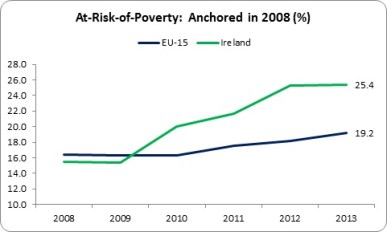
The picture looks dramatically different. We find that 25 percent of the Irish population are below the poverty thresholds frozen at 2008 levels (with only an inflation increase). It is well above the EU-15 levels. Relative poverty has increased by 64 percent, against a rise of 17 percent for the EU-15. Ireland had the highest growth rate in poverty, apart from Greece.
The rise in anchored poverty rates and deprivation rates are now more in sync.
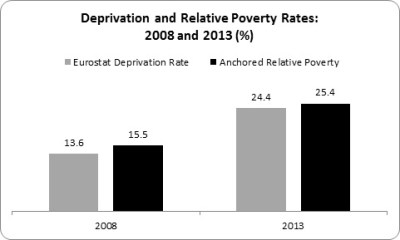
The growth in deprivation rates (using Eurostat’s measurement) and anchored relative poverty mirror each other.
Arguing that poverty has not increased over the recession is based on a statistical illusion. The reality on the ground – and the reality when we use more appropriate measurements – is that poverty has increased and increased substantially.
So when you hear a Government spokesperson going on about how we have ‘protected’ people from rising poverty, know that they are just avoiding the hard work of actually fighting poverty – relying instead on eliminating poverty through a statistical sleight-of-hand.
One more example of official detachment from the real world.
 Notes on the Front
Leave a comment