
 Fourteen Unite members are currently on strike at a site in Kishogue, Lucan, County Dublin where a new school is to be built. The outcome of this industrial struggle between a handful of workers and one of the leading building contractors in the country could have enormous implications for workers not only in the construction sector but in all sectors affected by sub-contracting and race-to-the-bottom employer strategies.
Here are the facts of the case. It all starts with the Department of Education. They put out a contract for building a new secondary school in Lucan. JJ Rhatigan & Co won the contract and became the main contractor.
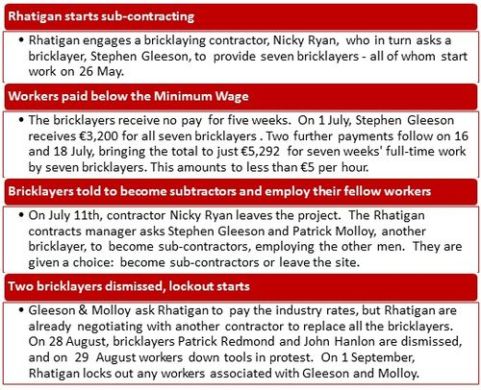
In a ballot on 11 September, Unite members on the site voted unanimously to take industrial action. The action commenced on 19 September and is continuing.
At root, this particular industrial struggle is about Rhatigan’s attempt to turn employees into self-employed in order to drive down labour costs (including avoiding paying employers’ PRSI and the construction pension contribution). As employees, these bricklayers would be paid €17.21 per hour – the industry rate. What Rhatigan did resulted in their pay being driven down to less than €5 per hour. When the workers protested against this they were either dismissed or locked out.
This process is called false or ‘bogus’ self-employment. As a SIPTU press release puts it succinctly:
‘Workers are being forced to masquerade as self-employed – despite clearly being employees – in order to drive wages lower and deny workers their pension and death-in-service entitlements, along with legal protection for holiday pay and other employment rights.’
While the Revenue Commissioners and the Department of Social Protection attempt to investigate claims of bogus self-employment, the trend towards such practices is increasing and escalating. That the Department of Education has, to date, tolerated these employment practices on its own contracts indicates that the Government and its agencies are taking confused and contradictory positions on this issue.
This is part of a general race-to-the-bottom. A lot of people associate this deflationary spiral with employers cutting pay – and there is an element of that. But the race-to-the-bottom has many instruments: bogus self-employment, agency work, contracting out, zero and low-hour contracts, precariousness, etc. It’s about pay, job uncertainty and uncertainty in working hours. It depresses overall income and, therefore, living standards.
This is a difficult struggle for the bricklayers involved in the Rhatigan dispute. It’s not just that strike-breakers are being bussed into the site so that work can continue. It’s that they are going up against one of the leading building contractors in the country.
J.J. Rhatigan & Co is listed in the top 500 companies in Ireland and 11th in the top property companies. It has a turnover of €100 million. It is responsible for some high profile buildings in the health and education sectors, churches, commercial and hospitality sectors. Through subsidiary companies it owns the Radisson Blu hotel in Golden Lane, Dublin. In particular, it is a favourite of the Department of Education, winning half of the contracts for school buildings in current construction phase. It is well-resourced – it has taken workers to the High Court, and in the current confrontation with the workers it has locked-out, it has hired a PR firm.
The company puts a lot of store in its image. It sponsors a race at the Galway Races and gives to charities. It states on its website:
‘ . . we are guided by firmly held values. We integrate corporate social responsibility (CSR) into these business values and operate a culture for successful projects influenced by CSR. JJ Rhatigan & Co has a culture which is grounded in integrity and respect. This means adhering to the highest standards and ethics. Our reputation as an ethical company is one of our most valuable assets.’
Interesting that a company that pays workers less than €5 per hour and refuses to engage meaningfully with the workers’ trade union representatives can claim this is consistent with corporate social responsibility, integrity and ethics . . . well, you figure that out.
There is a crisis of low-pay. The OECD’s newly published 2014 Employment Outlook places Ireland at the top of the low-pay table for EU countries.
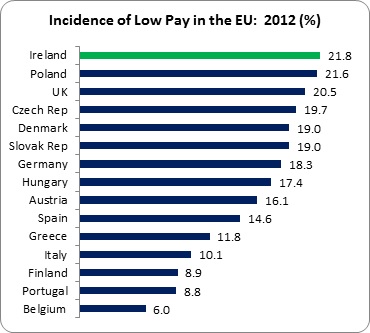
However, this doesn’t count workers that are forced into false self-employment and end up earning extreme low income – because they are not counted as ‘wage earners’.
Low-pay, bogus self-employment, poor fixed-term contracts, outsourcing and contracting out, and zero/low hour contracts – this is the world of work that is being created for us; this is one of the foundation stones for economic recovery.
We are slowly but steadily being Rhatigan-ised. But a handful of workers out in Lucan are fighting back, just as the Greyhound workers fought back. We need to build on the determination of these workers and force these issues on to the national agenda.
If not, there will be no economic recovery for hundreds of thousands – who will end up working to ensure that companies like J.J. Rhatigan build up their profits while at the same time claiming this is all ethical and socially responsible.
It will be a highly hypocritical and impoverished place to work.
 Notes on the Front
Leave a comment