
 In the excellent Irish Times series on the Living Wage, Mark Fielding, Director of ISME (Irish Small and Medium-Sized Enterprises) has put it bluntly to workers and the nation:
‘It’s not our responsibility to give someone a living wage.’
That’s telling them, Mark. You want a wage that can afford you a minimum adequate standard income, don’t come to us. Not our problem. Be lucky to have a job – if we decide to hire you.
This is Thatcherism Irish-style. There is no such thing as society, only Mark’s members. But to be fair to Mark, he’s got form on this issue.
‘ISME chief executive Mark Fielding called on the Government to scrap the minimum wage . . . He said the minimum wage had failed to benefit the low paid . . . ‘
So scrapping the minimum wage would ‘help’ the lower paid. Hmmm.
Mark is at pains to explain the extraordinary burden his members suffer:
‘The minimum wage is €8.65. But it’s really €9.68, when you take into account employers’ PRSI contributions.’
Oh, my – a wage floor of €9.68 per hour. That sounds really bad. Workers in our hospitality sector (hotels and restaurants) must be really costing Irish employers a bomb – especially in comparison to other EU-15 countries. But is this the case?
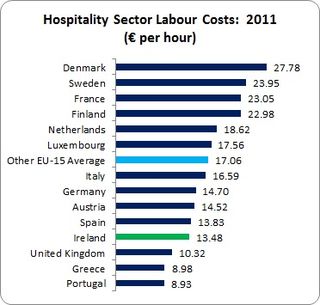 Our labour costs (made up almost exclusively of wages and employers’ PRSI) are far lower than most other EU countries in the graph. Labour costs would have to rise by 27 percent just to reach the mean average; they would have to rise by over 50 percent to reach French levels.
Of course, this data (the latest from Eurostat) is from 2011. Maybe Mark is worried about recent trends in low-paid sectors. Let me put his mind at ease. Irish labour costs in hospitality rose by 1.3 percent up to 2013; in the EU they rose by 3.2 percent. We’re even further behind.
That a representative from a business organisation would give out about wages, or paying higher wages, or even paying a decent wage is nothing new or unexpected. However, this ‘whether-people-can-live-on-the-wage-I-pay-has-nothing-to-do-with-me’ position got me to thinking: do all employers think like this? Would they all agree?
It’s hard to say in this country where the debate is dominated, loudly and persistently, by so many Mark Fieldings. But it is interesting to take a look at business organisations overseas, in the US, where such groups are no slouch when it comes to promoting their economic interests.
Majority Of Employers Say Raise The Minimum Wage
Forbes magazine reports that in a survey of human resource managers (the folks that hire and fire you) 83 percent not only think there should be a minimum wage, but say it should be higher than it is now. With the current US minimum wage at $7.25 per hour, 55 percent even stated it should be raised to at least $10 – a rise of 38 percent. But here’s something:
‘An ironic twist is that 70 percent of businesses that currently hire minimum wage workers were more likely to support an increase in the level, compared to the 59 percent of businesses that were not hiring minimum wage workers.’
And it’s not just big businesses. This comes from a survey conducted by the Small Business Majority:
- 57 percent support increasing the minimum wage to €10.10 over two-and-a-half years and adjusting it yearly to reflect the cost of living
- 61 percent in the retail and restaurant industries support increasing the minimum wage $10.10 – reflecting the above survey which showed that more employers in the affected sectors support wage increases.
- More than half of believe increasing the minimum wage will boost consumer demand for small businesses, helping them grow and hire.
And here’s the kicker – only a minority (35 percent) were Democrats. Republican-dominated small businesses want to substantially increase the minimum wage.
There are a number of business groups that take a contrary view to Mark’s social agnosticism.
Business for a Shared Prosperity – which describes itself as ‘a national network of forward-thinking business owners, executives and investors' – has taken a high profile on a number of issues, including organising a petition among business owners demanding an increase in the minimum wage to over €10 per hour. Have a look here – you may recognise a number of the businesses. And note that the South Carolina Small Business Chamber of Commerce and the Greater New York Chamber of Commerce are signatories – maybe our own Chambers Ireland could take note. The group features an interesting quote:
‘It is a sound business decision to increase the minimum wage. It increases sales. It increases employment. I have found that without exception in the successful ventures we've backed, providing sustainable living wages yielded direct increases in productivity, job satisfaction and brand loyalty from customers, all contributing to higher returns for investors and employers.’
That was said by Adnan Durrani – and he is president of a venture capital firm.
The Main Street Alliance – a small business organisation – calls universal health care, full disclosure of corporate political donations, an end to off-shore tax dodging and for progressive immigration reform (with a roadmap to citizenship). They state:
‘Decades of failed trickle-down economics . . . have driven a race-to-the-bottom in wages that is destroying the middle class [American term so elastic it includes most employees] and decimating the small business customer base. Consumer demand from a thriving middle class is essential to small business success. The economy is built from the bottom up, not the top down. Living wages and family-friendly workplace policies are an investment in your most valuable asset. Living wages and paid leave policies improve employee retention, morale, and productivity . . . No one should work full-time and live in poverty.’
And this from the American Sustainable Business Council which seeks to promote a sustainable economy that provides economic development along with shared prosperity, environmental protection, and social justice.
‘From a moral standpoint, we recognize the fundamental rights of all people to develop their talents, earn a living wage, and be treated with dignity in the workplace. From a pragmatic standpoint, without sustainability our economy will stagger under the weight of rising inequality and other externalities. All people engaged in the economy are interdependent. Each is both consumer and producer, both earner and spender. These roles must be kept in balance: Jobs are created when consumers have money to spend, and destroyed when they don’t. Companies can’t succeed unless customers have money to spend and the confidence to spend it.’
Let’s not forget – these are business people and business organisations. They’re in business to make profits. They know their bottom-line. And I’m not suggesting these are representative of US business as a whole – which is invested with social and economic piranhas, closer to Goldman Sachs, famously described as ‘a great vampire squid wrapped around the face of humanity, relentlessly jamming its blood funnel into anything that smells like money.’
But they understand the first rule of business: there is no business in poverty. Business cannot prosper in economic conditions dominated by low wages, deprivation and social degradation. Business requires confident and assured people whether they are employees or consumers; a confidence and assurance that comes from a strong living standard, respect and enhanced life-choices. And they understand that business has a role to play in creating this society.
And that’s what Mark and so many other ‘spokespersons’ for Irish business don’t understand. It’s not up to me to suggest that the members of ISME might want to consider a new leadership that does get it. But certainly businesses in Ireland shouldn’t let people misrepresent their interests and their values. They should speak out, form a new business organisation if needs be.
Most of all they should try to find a way to work with those who want to build a new, prosperous living wage economy. We will still have disagreements on a range of issues, important disagreements on important issues. But on the issue of the living wage, let there be discussion and cooperation.
We can all win.


 Notes on the Front
Leave a comment