Notes on the Front

Commentary on Irish Political Economy by Michael Taft, researcher for SIPTU

By This TIme Next Year We Could End Homelessness

Let’s start with the conclusion: if by this time next year if there are people still homeless, it’s because the Government made a policy choice.  And the policy choice was to tolerate homelessness.   

Now, back to the beginning.

The Government will be spending €7.1 billion this year.  It won’t be spent on public services, or social protection or investment.  And there will be no debate on it.  There will be no current affairs programmes, no panel discussions, no commentaries in the print media.  The Government will spend €7 billion this year and very few will know.

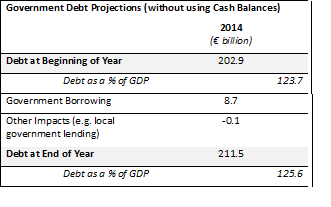
This €7 billion is being spent on paying down debt.  It comes from the Government’s considerable cash balances.  At the end of 2013, the Government held €18.5 billion in cash.  This is made up of money that has already been borrowed and revenue from bank investments (e.g. bonds held in Bank of Ireland, etc.).  The Government is taking the €7 billion and paying down Government debt to lower the debt/GDP ratio.  This is how it works:
Paying Down Debt 1

As seen, debt at the beginning of the year is estimated to €203 billion.  The Government will be borrowing €8.7 billion.  This results in a debt of €211.5 billion.  Debt is rising – both in absolute terms and as a percentage of GDP.  That’s because economic growth is low and we still have a deficit.

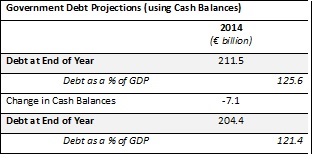
However, the Government will be taking €7 billion from their cash balances to write down debt.  This changes the level of debt.  Let’s continue the table above.
Pay Down Debt 2

When the Government does this – use €7 billion to pay down the debt – the level of debt falls, in both absolute terms and as a percentage of GDP. 

Here is the question:  is using that €7 billion to pay down debt the best use of that money?   In the following I’d like to put forward an alternative use for that money and see what issues that throws up.

There are 90,000 people on the social housing waiting list.  There are an estimated 5,000 people homeless at any one time.  And there are tens of thousands of unemployed building workers – many of whom are being forced to emigrate.  So let’s take half of that money the Government is using to pay down debt – €3.5 billion – and use it to build social houses, house the homeless and put some people back to work.

The Minister for Housing estimates that it costs €162,000 to build a single social house unit.  This is based on requests for small developments from local authorities so this can’t be taken as average cost.  I’ve seen lower estimates but let’s work with this. 

The €3.5 billion would build approximately 20,000 social houses.  This would house over 20 percent on the waiting list. And this programme could target the nearly 3,000 living in emergency accomodation.

This would make a significant impact on housing need in Ireland – though it would only be a beginning.  More housing could be brought on stream if currently unsuitable social housing were brought back into the system – the average cost of rehabilitating social houses is €17,500.

The impact on employment would be considerable.  35,000 direct jobs would be created – that is, jobs on site.  NERI estimates further job creation given the impact on downstream sectors (building supplies, transport) and the additional demand injected into the economy.

Pay Down Debt 3

In the year that the social houses are built, nearly 60,000 jobs are created.  Of course, once a house is built you can’t rebuild it.  The need for labour goes away as it is a temporary expenditure.  However employment still increases because of the demand that was injected into the economy – even on a once-off basis.  A programme of building over 20,000 social houses this year will still mean a permanent employment increase of 3,000 by 2018.  That’s a big boost.

Stay with the NERI estimates economic growth would also be higher.   By 2018 GDP could by more than €800 million higher.

And what about public finances?    The €3.5 billion expenditure would not require extra borrowing – don’t forget, the money in the cash balances has already been borrowed.  So, neither would it require any extra taxation nor compensating spending cuts in other areas.

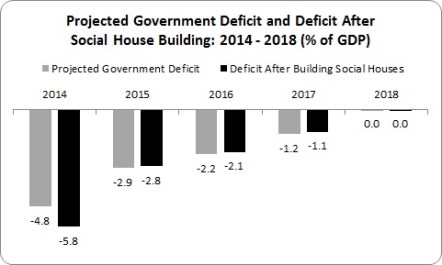
However, it would appear on the books – that is, it would drive up spending in 2014 and, therefore, the deficit.  But there be would be no negative impact next year.  If anything, it would have a positive impact down the years.
Pay Down Debt 4

In 2014 the deficit would rise by one percent.  Is that important?  No.  The Minster for Finance has continually stressed that the goal is to reduce the deficit – as per the Maastricht requirements – to 3 percent by 2015.  Since the expenditure is a once-off, it is not repeated in 2015.  In fact, the deficit falls even further than the Government projections after 2014 because of the extra demand injected in the economy.  If anything, building social houses brings more manoeuvrability to public finances, not more restraint.

The only downside – if you want to call it that – is that by 2018 the General Government Debt will be 108.6 percent of GDP rather than the Government’s estimate of 107.2 percent.  Any reasonable response to that would be:  so what? 

Let’s recap.  Ending homelessness and reducing the social housing waiting list by nearly 20 percent would:

  • Entail no extra borrowing, no additional tax increases, and no compensation spending cuts
  • Increase employment by 60,000 in the year that the houses are being built; after that employment would experience a permanent increase of 3,000 annually.
  • While the deficit would rise in 2014, from 2015 on the deficit would actually fall faster that Government projections.

There are other benefits.  Spending money on hotel rooms for homeless would be eliminated.  Further, 48 percent of those social housing waiting lists are in private rented accommodation receiving rent supplement.  On average, for every 1,000 social housing units built, the state would save €2.3 million on supplementary payments.  And more rental accommodation becomes available on the open market.  This would put downward pressure on rents and mean that private sector tenants would have more money to spend in the consumer economy.  There any number of benefits from building more social housing.

The only argument that could be made against this proposition is that the EU Commission would oppose it.  Would they?  Would they say – we don’t want the deficit to fall faster, we don’t want more tax revenue, less public spending, higher growth, more people at work, less people homeless and fewer people waiting on housing lists?  I know that many people don’t think much of the EU Commission but they’re not irrational. 

This is one alternative to the Government’s decision to spend €7 billion on paying down debt.  Building social housing to house the homeless is both socially equitable and economically efficient. But first we have to start a debate about this.  We have to put it in stark terms.

To conclude (again):  if by this time next year if there are still people are homeless, it’s because the Government made a policy choice.  And the policy choice was to tolerate homelessness.   

The good news is that it doesn’t have to happen.


2 responses to “By This TIme Next Year We Could End Homelessness”

  1. The Dork of Cork Avatar
    The Dork of Cork

    There is no need or demand to build houses.
    Indeed we cannot afford to maintain the stuff which was already over supplied which require very considerable inputs.
    many 1000s of houses are empty in cities and market towns of Ireland.
    However many people do not have the purchasing power to live in houses.
    The solution is simple – give people a national dividend while banning the production of bank credit which maintains a artifical scarcity of such units.
    No need for a centralized solution then Micheal.

    Like

  2. The Dork of Cork Avatar
    The Dork of Cork

    DRAFT SOCIAL CREDIT SCHEME FOR SCOTLAND (Y1933)
    (1) Obtain from existing sources, such as company balance-sheets, land registration
    offices, and insurance companies, such information necessary to place a money valuation
    upon the whole of the capital assets of Scotland, such as land, roads, bridges, railways,
    canals, buildings, drainage and water schemes, minerals, semi-manufactured materials.
    No distinction between public and private property. Replacement values to be used where
    the property is in use.
    Add to this the sum representing the present commercial capitalised value of the
    population. Such a figure exists and varies with the actuarial expectation of life and the
    plant capacity of the country, and is something like £10,000 for a citizen of the United
    States at the age of twenty-five. From the grand total thus obtained a figure representing
    the price value of the Scottish capital account could be obtained. (205) Financial credit to
    any equivalent can be created by any agency such as a Scottish Treasury empowered by
    the Scottish people.
    (2) As from the initiation of this scheme, the holding of any stock, share, or bond by a
    holding company or trustee will not be recognised. It is the intention that no shareholding
    in any industrial undertaking shall be other than in the form of equity shares of no par
    value, i.e. preference or common shares or stock. Bonded indebtedness will be recognised
    for purposes of compensation where held by individuals, upon a proper investigation, but
    where held by corporations will be subject to such terms of redemption as may seem
    desirable.
    No transfer of real estate directly between either persons or business undertakings will be
    recognised. Persons or business undertakings desiring to relinquish the control of real
    immovable estate will do so to the Government, which will take any necessary steps to
    re-allot it to suitable applicants. No Government Department shall administer either
    directly or indirectly any business, whether agricultural, productive, or distributive, other
    than the administration of the financial and credit schemes, or receive payment for any
    services rendered to the public, other than in bulk. (206)
    THE INITIAL NATIONAL DIVIDEND
    (3) For the purpose of the initial stages an arbitrary figure, such as 1per cent of the capital
    sum ascertained by the methods outlined in clause (1), shall be taken, and a notice
    published that every man, woman, and child of Scottish birth and approved length of
    residence, with the exception mentioned in the paragraph that follows, is to be entitled to
    share equally in the dividend thus obtained, which might be expected to exceed three
    hundred pounds per annum per family. It will be clearly understood that no interference
    with existing ownerships, so called, is involved in such a proceeding. The dividend to be
    paid monthly by a draft on the Scottish Government credit, through the Post Office and
    not through the banks.
    Any administrative change in the organisation of the Post Office should specifically
    exclude transfer of the money and postal order department and the savings bank. No
    payments of the national dividend will be made except to individuals, and such payments
    will not be made where the net income of the individual for personal use, from other
    sources, is more than four times that receivable in respect (207) of the national dividend.
    The national dividend will be tax-free in perpetuity, and will not be taken into
    consideration in making any returns for taxation purposes, should such be required.
    Except as herein specified this dividend will be inalienable.
    “ASSISTED PRICE” FOR REGISTERED BUSINESSES
    (4) Simultaneously with the publication of the foregoing notice a figure to be published
    known as the discount rate, to replace the existing bank discount rate, a suitable value of
    this for initial purposes being 25 per cent. It is important that the figure should not be less
    than 25 per cent, and it might reasonably be higher.
    (5) Simultaneously, an announcement to be published that any or all business
    undertakings will be accepted for registration under an assisted price scheme. The
    conditions of such registration will be that their accounts, as at present required under the
    Companies Acts, should contain an additional item showing the average profit on
    turnover, and that their prices shall, as far as practicable, be maintained at a figure to
    include such average profit, (208) where this is agreed as equitable for the type of
    business concerned (the suitable profit being, of course, largely dependent on the velocity
    of turnover). Undertakings unable to show a profit after five years’ operation to be struck
    off the register.
    HOW FREE CREDITS WOULD BE ISSUED
    (6) In consideration of the foregoing, all registered businesses will be authorised to issue
    with sales to ultimate consumers an account on suitable paper for use as explained in the
    following clause.
    (7) Payment for goods will be made in the ordinary way, either by cheque or currency.
    The purchaser will lodge his receipted account for goods bought with his bank in the
    same way that he now pays in cheques, and the discount percentage of the amount of
    such account will be recredited to the consumer’s banking account. Unregistered firms
    will not be supplied with the necessary bill forms for treatment in this manner, with the
    result that their prices will be 25 per cent, at least, higher than those of registered firms.
    (It is obvious that the larger the discount rate can be made, the greater will be the
    handicap of the non-registered firms.) (209)
    The total of the sums credited by the banks to private depositors in respect of these
    discounts will be reimbursed to them by a Scottish Treasury credit. The capital account
    will be “depreciated” by such sums, and “appreciated” by all capital development. The
    existing banks will be empowered to charge an equitable sum for the services thus
    rendered.
    HOURS AND WAGES
    (8) The hours of Government offices will be reduced to four hours per day. To meet the
    temporary congestion of work, additional staff will be employed, such staff, however,
    doing identical work with the existing staff in the form of a second shift, and sharing with
    the existing staff the chances of promotion irrespective of seniority. (The object of this is
    to discourage the well-known bureaucratic tendency to enhance the importance of
    existing staffs by employing additional numbers of persons ranking by virtue of seniority
    below the original officials, and, at the same time, to afford an opportunity of appointing
    a duplicate set of officials to check reaction without dislocation of existing routine.)
    (9) Wage rates in all organised industries (210) will be reduced by 25 per cent where such
    reduction does not involve a loss to the wage-earner exceeding 20 per cent of the sums
    received in the form of national dividend. The wage rates ruling in 1928 to be taken as
    the basis against which the reduction would be made.
    Any trade union violating a wage agreement to render its membership liable to
    suspension of national dividend, and any employers’ organisation committing a similar
    offence, to be liable to suspension of price assistance or wage reduction.
    MUST ACCEPT EMPLOYMENT, OR–
    For a period of five years after the initiation of this scheme, failure on the part of any
    individual to accept employment in whatever trade, business, or vocation he was
    classified in the last census, under conditions recognised as suitable to that employment
    (unless exempted on a medical certificate), will render such individual liable to
    suspension of benefit in respect of the national dividend.
    (10) Taxation of specific articles or specific forms of property to be abolished. Any
    taxation found to be necessary to take the form either of (211) a flat non-graduated
    taxation of net income or a percentage ad valorem tax upon sales, or both forms of
    taxation together.
    CH Douglas
    Y 1933.

    Like

Leave a comment

Navigation

About

Commentary on Irish Political Economy by Michael Taft, researcher for SIPTU