Notes on the Front

Commentary on Irish Political Economy by Michael Taft, researcher for SIPTU

In Ireland, the Jobs River Flows Uphill

There’s a lot of confusion out there.  IBEC found the recent fall in consumer spending ‘puzzling ‘ – what with all the increase in employment.  Others have found it strange, too – strong employment growth but falling consumer demand.  Shouldn’t the big increase in employment translate into higher consumer spending and domestic demand?  What’s going on here? 

Well, it’s only puzzling if you accept that employment grew by 60,000 over the last year.  However, once you lift the lid on the numbers and find that the 60,000-growth number in the CSO’s Quarterly National Household Survey (QNHS) is a statistical quirk, then it starts to make sense. 

First, let’s note the CSO’s warning about interpreting trends in employment growth during the period they are realigning their sampling base with the 2011 census.  This realignment ensures that their Quarterly National Household survey sample is aligned with the population.  They do this after each census.

‘After each Census of Population the sample of households for the QNHS is updated to ensure the sample remains representative. The new sample based on the 2011 Census of Population has been introduced incrementally from Q4 2012 to Q4 2013. This change in sample can lead to some level of variability in estimates, particularly at more detailed levels and some caution is warranted in the interpretation of trends over the period of its introduction.’

Now let’s look at the employment numbers.  Between the 4th quarter in 2012 and 2013, employment grew by 60,900 – or 3.3 percent (not seasonally adjusted).  However, self-employment grew by 33,400, or 11.5 percent.  So, self-employment made up 55 percent of all employment growth.  Is this realistic?  No.

  • In the pre-crash period between 2000 and 2007, domestic demand grew annually by 6 percent.  On the strength of this self-employment, which would be almost wholly reliant on domestic demand, grew by an annual average of 3.4 percent.
  • In the last year, domestic demand flat-lined (it grew by 0.3 percent).  Yet self-employment grew by 11.5 percent.

Are we really expected to believe that self-employment grew 3.5 times faster than during the boom years – when domestic demand was stagnating?  Are expected to believe that rivers flow uphill?

So what are we to make up of this?  Davy Stockbrokers identifies the problem.  They hone in on the agricultural sector which also shows a phenomenal increase.  While total employment grew by 3.3 percent over the last year, agricultural employment grew by 30 percent.  This reflects the growth in self-employment.  Regarding these self-employment/agricultural numbers Davy states:

‘ . . . the current sectoral split of the jobs numbers is not reliable. The introduction of a new population sample following the 2011 Census means the sectoral split has been skewed, particularly in relation to agricultural employment. This over-estimation is due to a reciprocal underestimation of agricultural employment after Census 2006.’ (bold is mine).

This is the key observation.  Adjusting for the 2011 census, the CSO has found that in the past, self-employment/agriculture numbers were under-estimated.  In other words, there were more people working in the economy than was previously thought.  Therefore, the current increase in employment is less than the 60,900. 

The CSO has warned on a number of occasions about interpreting trends during the period they are re-aligning their survey sample.  The Government knows this but Ministers still go about claiming 60,000 new jobs, ignoring these warnings and, so, misleading the debate on this crucial issue.

We won’t be able to make reliable comparisons on overall employment growth until the last quarter of this year.  That’s because the CSO has been incrementally introducing the new sample over the previous year. 

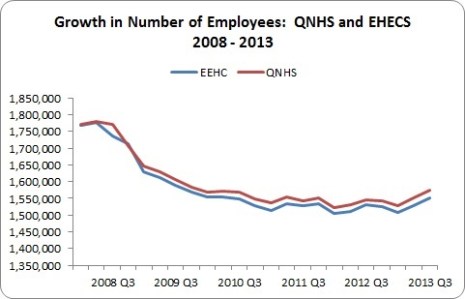
Is there any part of the employment figures that are reliable for assessing current job creation trends?  Fortunately, yes.  We can reasonably rely on the category of ‘employees’ because the CSO has two surveys on employee numbers – the QNHS and the Earnings Hours and Employment Costs Survey (EHECS).  The latter is a survey of employers and measures employee numbers, hours and wages. There is a slight difference.  The survey of employers excludes agricultural employment and micro-enterprises (companies with two employees or less).  So this will show slightly lower number of employees.

However, if the trend in employee numbers in these two surveys mirrors each other, we can assume they are reasonably robust.  And that’s what exactly what happens.
Magic Road

The trend – whether falling or, more recently, rising – mirror each other almost exactly.  This suggests that we can rely on the employee numbers in the QNHS. 

Now on to puzzle-solving.    In the last year, the QNHS showed an increase of 28,300 employees, a 1.8 percent increase.  This is not an insubstantial amount; however, it is far below the 60,000 headline number.  [Just to note, 2,300 of this increase was due to increased participation in labour activation schemes such as JobBridge].

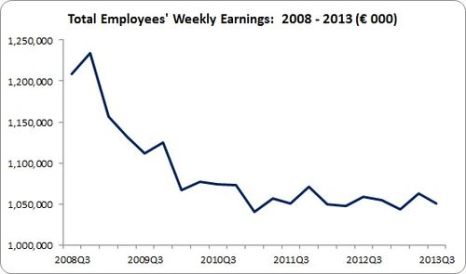
However, at the same time, weekly income was falling.  Overall wages (weekly earnings) fell in the last quarter we have data for (the 3rd quarter of 2013).
Magic Road 2

Due to the fall in weekly earnings, total wages in the economy has not been increasing despite the increase in employee numbers.  There are a few caveats, here.

  • Preliminary data for the final three months last year shows that weekly earnings rose slightly.  However, the number of employees actually in the final three months – by more than 2,000 (I bet you didn’t hear about that in all the celebration of the job numbers).
  • This doesn’t count income from the self-employed.  But we don’t have an average income for the self-employed and, as we saw above, we can’t rely on self-employment numbers.
  • A number of people will have signed off the Live Register to take up work over the last year.  Therefore, the actual increase in total income in the economy will be less (you’d have to subtract the social protection income from the wage income to get the net gain).
  • And when you consider that people are trying to pay off debts, much of the extra income going to the consumer economy would be less.

So there shouldn’t be any confusion about why consumer spending fell in the last year – once you’ve accepted that the headline growth rate in total employment is unreliable and factor in declining weekly income. 

That’s why domestic demand remains flat.  That’s why consumer spending is still falling.  There’s no puzzle here.

Just an economy that is stagnating.

NOTE:  I will look at where the jobs are being created in a post next week. 

4 responses to “In Ireland, the Jobs River Flows Uphill”

  1. Gerard Brady Avatar
    Gerard Brady

    Micheal,
    Your analysis is frankly wrong and based on a common confusion about how the QNHS survey works and how it has been effected by introduction of the new census sample. Since the beginning of the gradual introduction of the new sample two years ago the CSO have consistently stated that the total employment number is sound and not affected by the introduction of the new sample. Only the sectoral and more granular figures are affected.
    The reason for this is that the overall employment numbers is not the sum of the sectoral figures. The sectoral figures are a disaggregation of the overall number. The overall number comes from a simple yes/no question (Q1). The question on which sector you are employed in comes after that and is separate. The overall number to Q1 is then disaggregated by Q2 afterward. Agricultural jobs are inflated at the moment, as is self-employment but it only effects the distribution of the jobs not the level. This is the key point on which you’re mistaken.
    Again the CSO have gone out of their way at every QNHS release for two years to clarify this and I am sure they would be happy to confirm this with you. You should reflect this in your article as it will only serve to erroneously muddy the waters on what are positive figures.
    On using EHECS numbers to look at private sector employment, again you should look closer at the survey. EHECS only looks at employees in firms with over three employees. Owners, the self- employed and individuals who work in a large chunk of smaller enterprises (the group of enterprises in which employment growth tends to be strongest) are not included.
    At the last count in 2011 your preferred source for employment numbers excludes 155,718 firms who employ over 220,000 people. Obviously, again you should reflect this clearly in the article.
    Finally, the level of employment in the private sector in EHECS is only 1.2 million there are several hundred thousand (almost 300,000 at my count) private sector workers not surveyed for the reasons outlined. This is also why the growth number is so much lower, these firms are where much job growth comes from internationally.
    Using your figures our unemployment level is close to 30% – Does this seem plausible to you?
    This again is all clarified in the EHECS releases and I’m sure the CSO would be happy to clarify.
    Your post is observably wrong and misleading and you should acknowledge that.
    Regards,
    Ger Brady

    Like

  2. Michael Taft Avatar

    Gerard – thank you for your comment. The issue of the overall number of people in employment per the QNHS is not in question. I did not question it and I have not read anyone who has. The issue is the trend while the CSO is re-aligning the sample and others, too, have suggested that past employment figures were too pessimistic. Hopefully, this will become clearer once we can make comparisons without the confusions thrown up by the re-weighting of the sample.
    I am perplexed by some of the comments you make and figures you refer to re: the EHECS. I didn’t use the EHECS to look at ‘private sector employment’ but rather all employment. Further, I stated the limitations of the survey regarding exclusion of agricultural employment and micro-firms (by the way, the EHECS looks at firms with three employees; they exclude firms with two or one).
    First, the QNHS uses the EHECS’s public sector employment estimate, claiming it has a higher response rate and is less subjective. Deducting the number of public sector employees – 376,300 (which includes public enterprise) – we get an estimate 0f 1,175,200 private sector employees. If you deduct the public sector number from the QNHS total number of employees, you get an estimate of 1,197,300. So the approximate 1.2 million private sector employees is pretty reliable. In this regard, I’m puzzled by your reference to 300,000 private sector employees ‘not surveyed’. Are you suggesting that there are 1.5 million private sector employees? I’d appreciate a clarification on that.
    Second, I certainly would appreciate any data you may have on the number of enterprises and employees where the firm size is either one or two employees. You refer to 155,718 firms and over 220,000 people. Is that your estimate of the number of enterprises and employees excluded from the EHECS (that is, firms of one or two employees)? The CSO’s business demography database only has data on firm size between 1 and 4. This shows that in the business economy there are 66,000 enterprises employing 127,000 in firms with less than 5 employees. The numbers would be smaller for firms of less than three – but it doesn’t include agriculture and the private sector element of the health sector and education sector. Still, it seems a long ways off from the numbers you refer to. Again, if you could clarify that, I’d appreciate it.
    Ultimately, it is about how one approaches analysis. I respect your opinion that I may be ‘muddying’ the water (though I respectfully don’t agree with it). However, analysis in the first instance isn’t about treating data as a positive or negative. The first step is to understand what it is.
    My post attempted to help address a little riddle – why is consumer demand stagnating even though we have strong headline growth numbers (not the magnitude). I then looked at employee numbers from two different surveys and found they corroborated each other. This raised the question of how robust the self-employment numbers are. Don’t forget, the QNHS not only asks are you working, they also ask ‘are you self-employed/an employee/an assisting relative/on a state-sponsored employment scheme’. It is unlikely that the distribution between these categories are affected.
    If you believe the self-employed numbers are robust maybe you could venture an explanation re: how can the number of self-employed grow at 3.5 times the boom-time rate, given that we are still in a domestic-demand recession. I certainly would be interested in your answer.

    Like

  3. Gerard Brady Avatar
    Gerard Brady

    I apologies if it came across that I was accusing you or deliberately muddying the waters. That was not my intention. I do think, however, that your, in my opinion flawed, interpretation of some of the numbers has the potential to.
    *Again the CSO have stood behind the total employment and employment trend figures for two years. It is not effected in either level or trend by the re-weighting. The only figures effected are the distribution of employment. In this I agree with you and it’s something the CSO have had raised with them at numerous releases and which they have been very careful to clarify.
    *The self-employment numbers are likely effected by the new sample as are all disaggregated number in the QNHS. This all comes from the same source of a problem as agriculture. What none of this does is effect the total employment number which is calculated from a simple y/n question before distributing into self employment, sectors etc. The total employment figure again is not effected by where people are employed as it is not the sum of the sectoral or type of employment figures, they are a disaggregation of it. Previously self employment and agriculture were underestimated during this disaggregation and their trends are questionable, on which we agree – the trend of overall employment is not.
    *Total employment in EEHCS is 1.57 million people. A full 330,000 short of total employment in the QNHS (1.9million). It has full coverage of the public sector but is incomplete when looking at overall employment due to its lack of coverage of the private sector. This is because the survey is designed to study wages not employment.
    Total employment in the QNHS is 1.9 million. I agree there are 376,000 public and semi state sector employees. I am confused as to how you are subtracting 376,000 from 1.9 million and coming up with 1.2 million private sector workers? By my math this leaves us about 300,000 employees short of 1.2 million. In short yes there are 1.5 million private sector workers.
    Your analysis suggests that there are just over 1.5 million total people in employment – 1.2million private, 370,000 public employed in the country. This would leave us with 28.5% unemployment from the labour force of 2.1 million.
    I attach the recent QNHS release which will confirm there are 1.9 million people employed in the country not 1.5 million as you suggest.
    http://www.cso.ie/en/media/csoie/releasespublications/documents/labourmarket/2013/qnhs_q42013.pdf
    The business demography also contains information on firms with zero employees. It shows there are 89,000 enterprises with zero employees (Sole-traders and the like). They are included in that estimate as they are employed and are not included in EEHCS as you’ve acknowledged. Your analysis disregards the self employment, people in micro-enterprises and people in agriculture. I cannot see how you think this does not leave a less reliable private sector employment figure or a less consistent total employment trend?
    I agree that consumption numbers in particular are confusing particularly when leading indicators such as retail sales and consumer sentiment are rising (Which would ties in with employment rises). I don’t have a firm answer on it but on spec one part of the puzzle may be that consumer patterns have observably changed over the crisis and this effects numbers (for example online retail is not included in retail sales figures).As always the Irish quarterly national accounts are extremely volatile so it may be something which receives more illumination in the couple of months time. If employment numbers continue to rise and consumption does not materialis in the next six months or so then I may agree with you its might be time to send out the search parties.
    Again thanks for your response.

    Like

  4. Gerard Brady Avatar
    Gerard Brady

    http://www.cso.ie/en/media/csoie/qnhs/documents/QNHSManual2012.pdf
    Micheal,
    See attached the QNHS questionaire guide. It is my uderstanding Q.40 is the relevant one for total employment.
    Q84 looks at self employment which si the questions you refer to.
    The results of Q.40 are total employment and were not effected by the sample change. The numbers coming from Q84 (ie self employment) may well have been as I understand have others.
    Whether employment is increasing at 3.3% is not in question (Q.40) the CSO have stated they are happy with these numbers as being accurate. Where these jobs are coming from is an issue (Q.80 and others) but they are two seperate issues. One does not effect the other.

    Like

Leave a comment

Navigation

About

Commentary on Irish Political Economy by Michael Taft, researcher for SIPTU