
If the Irish Times report is correct, the Government is on track to implement tax cuts for ‘middle income’ families. The Taoiseach is certainly keen on it:
‘“The priority will be to reduce the very high tax rates faced by families on middle incomes,” said Mr Kenny.’
What’s really interesting is that for many middle income families, tax cuts would be practically meaningless. And what they need is not even on the agenda.
How much income do middle income households earn? The following should only be seen as an approximation since it relies on income distribution data from the Survey on Income and Living Conditions which presents the information based on deciles (i.e. broken down on 10 percent categories). Further, the latest Survey from 2011 doesn’t provide a decile breakdown; so this data is courtesy of Dr. Micheal Collins from the Nevin Economic Research Institute. As well, the household breakdown comes from 2010 (again, as 2011 doesn’t present this data) – a breakdown for adults and children. That’s why this should be treated as indicative.
This middle income lies in the 4th to 8th deciles, making up 55 percent of all adults and 60 percent of all children. What is the average income for this middle group?
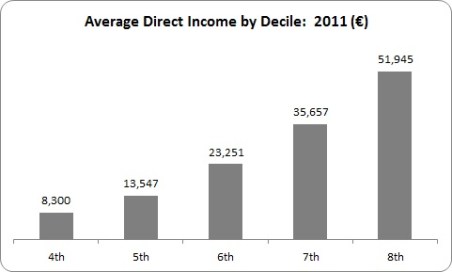
It ranges between €8,000 and €52,000 per household. This refers to ‘direct’ income – income from PAYE work, self-employment and capital sources (e.g. capital gains). This middle income group is made up of part-time workers, minimum wage workers, and the low-paid: a household of two working adults would mean average gross wage of €26,000 each. There would also be average and above-average income earners.
Data from the Revenue Commissioners is also helpful but there are some caveats. There is a chance that there is double counting – where people might have part-time self-employment combined with part-time PAYE work. Further, married couples are counted as one taxpaying unit. And the data only includes those in work. Notwithstanding these, the Revenue data corresponds with the above.
When you exclude the top and bottom 22 percent from the income distribution – leaving the middle 56 percent – we find that incomes range from €12,000 and €50,000. As per above, we should remember that many of these taxpaying units are married couples which means that a couple with €50,000 equates to €25,000 each – relatively low-paid. The fact is that the median income (the midway point at which 50 percent earn above and 50 percent below) is approximately €27,000.
If we just look at ‘couples’ in the Revenue data (they don’t provide a category for single parent households; nor do they take account of ‘single’ people living together) we find the following:
- For married couples, one earning, the median income is approximately €30,000. This means that 50 percent of this group earn below and above that level.
- For married couples where both are earning, the median income is approximately 52,000.
Unfortunately, this data comes from 2010 but the numbers won’t have changed that much, what with stagnating wages.
The Taoiseach specifically referred to 'very high tax rates' that middle-income families face. The fact is that most middle income households pay a relatively low rate of tax (I'm assuming the Taoiseach is referring marginal tax rates – the rate someone pays for each additional Euro earned).
- For single parents and couples earning below €25,000 (a substantial amount as we saw above), the marginal tax rate is 11 percent – USC and PRSI combined.
- For a married couple (one earner) with an income below €41,900, the marginal tax rate is 31 percent – Income tax, USC and PRSI combined. According to Revenue's 2010 data, approximately two-thirds of this group earn below €41,900.
- For a married couple (two earners) with an income below €65,600, the marginal tax rate is 31 percent. Again, according to the 2010 Revenue data, this represents over 60 percent of that group.
So a considerable majority of middle-income households do not pay high marginal tax rates.
This tells us two things. First, many middle-income households are not in the income tax net. A couple, whether one or both earning, and single parents do not enter the income tax net until they earn nearly €25,000. Even when they are slightly above the income tax threshold, the income tax is so low that a cut would net only a marginal amount. Take a couple with one person earning €30,000; the income tax contribution is €1,000 a year – though this would probably be less if there are tax reliefs for medical insurance, pension contributions, mortgage interest, etc. If the amount of tax paid were reduced by 10 percent, it would only come to €2 a week. For many, if not most, middle income families an income tax cut would have no or only marginal benefit.
Of course, this refers only to income tax cuts. The Government could cut USC and/or PRSI. But it appears that income tax is the target. In any event, cutting USC and / or PRSI could be very costly unless it is carefully targeted.
But secondly, these numbers can help tell us what middle-income households do need.
- They need a pay increase, especially those at the lower end of the middle income group: an increase in the minimum wage, strong wage floors under the revamped Joint Labour Committees, pay rises that that give emphasis to the low paid.
- Middle income households with children need affordable childcare (imagine the benefits from a reduction of childcare fees from €800 a month to €250 a month), truly free education including uniforms, bus transport, schoolbooks, hot lunches and an end to 'voluntary' fees.
- Middle income households need free GP care and heavily subsidised prescription medicine, affordable nursing care for their elderly relatives, stronger income supports such as maternity benefit, certainty in retirement income, subsidised public transport.
Middle income households – like low-income households – need a range of services and supports to increase living standards.
The problem is that you can’t have an increase in public services and social protection while cutting taxes. It would be disingenuous to suggest otherwise. And the Government looks set to sacrifice the measures needed to improve the living standards of low and middle income households – all in the name of tax cuts which are not relevant to so many.
So here's a question for the Taoiseach, the Government and anyone else who is calling for tax cuts for 'middle-income' families: what do you mean by 'middle income'?

 Notes on the Front
Leave a comment