
While Eurozone Governments continue to debate the details of
the banking union; while the Irish government continues to insist that the deal
reached last year includes bailing us out for past bank debt; while commentators
debate and measure the link between public and banking debt; while the
ECB steps into the void with its own peculiar version of ‘breaking the link’
between banks and states – while all this is going on,
that game-changer which would break the link between state and banking debt is becoming
ever more elusive.
With the latest data from Eurostat we can track the impact
of banking debt on the public finances of Eurozone governments.
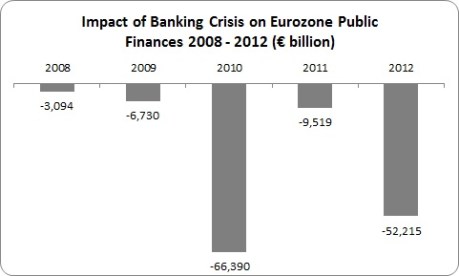
2010 was the worst year – with plucky little Ireland
contributing nearly half of the total €66 billion. It eased off in 2011 but it came back with
force in 2012. In total, the banking
debt has cost the Eurozone €138 billion but this is just the Eurostat’s
accounting of the largely capital impact on General Government Debt. It doesn’t include interest payments, cost to
wealth funds (such as Ireland’s National Pension Reserve Fund) or the impact of
contingent liabilities, never mind the impact on the economies in general. So this is a narrow accounting of a cost
which is much, much higher.
Who got hit in 2012?
Ireland didn’t. In fact, we
recorded a small income increase due to bank repayments (€1.6 billion). The main victims, however, can be found in
the periphery. Spain, Greece and
Portugal accounted for 86 percent of the net impact on the Eurozone in 2012. Spain, in particular was hit, with an impact
of €39 billion on their public books. But
other countries got hit: Belgium, Germany, Austria, France and the UK with
minor impacts in other countries. In
short, 2012 was the second worst year since the crisis began.
But the fun doesn’t stop there. There are two more tables which show the
continuing bank-debt burden on the Eurozone.
First, is the relationship between the stocks of government financial
assets and liabilities arising from the support of financial institutions in
the crisis.
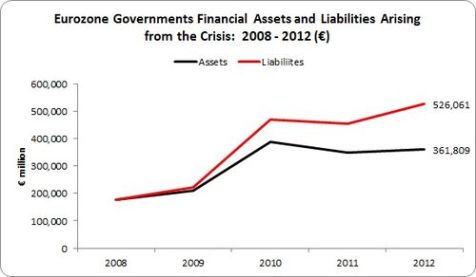
In 2012, Government liabilities rose to €526 billion – with assets
valued at €362 billion. What is
noteworthy is the continued growth in liabilities and the widening gap with assets. Net liability is now at €164 billion.
How does Ireland stand in this category? In 2012 Ireland had €46.2 billion in
liabilities while it held -€700 million in assets (yes, that’s right, minus
€700 million – don’t cash in those AIB shares just yet) leaving a net liability
of €47 billion. That’s 29 percent of the
Eurozone’s total liability.
The second category is contingent liabilities. Most of these are comprised of guarantees (we
know something about that).
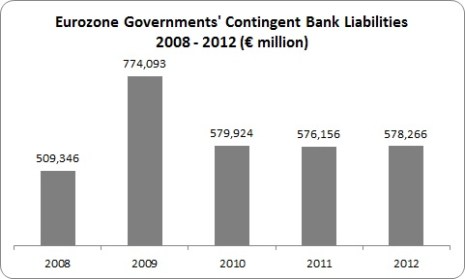
Contingent liabilities have flat-lined since 2010, with
half-a-trillion Euros potentially impacting on Government finances. This
is concentrated, again, in the periphery – 65 percent of contingent liabilities
being shouldered by Ireland, Spain, Italy, Greece and Portugal. Ireland finds itself with €113 billion of
those contingent liabilities, the highest of any EU country.
Of course, only the most pessimistic among us would think
that all these liabilities will find their way on to state books. However, if this crisis has taught us
anything, it’s that pessimism is the new realism.
But this is not a static picture. Ireland should be released of some of these
contingent liabilities with the ending of the bank guarantee (though we are
still on the hook for the state-guaranteed borrowing under that scheme). ANd hopefully the assets we hold will start to grow in value. However, we have those bank stress tests
coming up. What are the odds on all our
banks coming through that with clean sheets?
And that’s where the ECB comes in. The EU’s official policy is to break the link
between state and bank debt (ok, ok, it’s a dead letter – but it is an official
dead letter). But the ECB seems intent
on strengthening that link. Over 100
banks will undergo the ECB’s ‘asset quality review’, or stress test. The banks that fail due to inadequate capital,
will be required the raise more capital in the markets. However, if they can’t the ECB has decreed
that national Governments will make up the short-fall through further
capitalisations. And that’s where
recourse to the European Stability Mechanism comes in; in effect, a
bail-out.
This puts in train the prospect of new bank debts hitting
the state books – over and above what Eurostat has identified above. And that the results of the stress tests won’t
be published until next year creates another period of uncertainty over bank
debt. In the case of Ireland, how will
this impact on us as we exit the bail-out?
There are lots and lots of downsides.
So we have hundreds of billions in bank debt impacting on
state debt with hundreds of billions more floating around looking for a new
home –potentially, people’s pockets.
And there’s no sign of a let-up.
Let’s cut through all the language and technical papers and
aspirations to confidence and stability. If you want to break the link between
the state and bank debt you have to put the bank debt back where it belongs –
in the financial sector. Anything short
means slapping people and state budgets with a debt they didn’t create. Strategies going forward – for Ireland, for
Spain, for all the peoples of the Eurozone and the EU – must begin again with
this simple and fundamental principle.
For let’s be clear – the link between state and bank debt
is, if anything, growing stronger. So
strong that it is strangling an entire region.
 Notes on the Front
Leave a comment