
Don’t be taken in by the spin. Social protection payments have not been
protected. Not ‘core’ payments, not ‘non-core’
payments, not any payments. They have
been cut in actual terms, they have been cut in real terms, they have been cut in value. This is why people’s living standards
continue to deteriorate. The Government
claims they are protecting social protection payments. This claim is false.
Before we get into the main argument, though, let’s clear
something up. When people complain that
social protection payments are actually being cut – like Child Benefit, rent
supplement and other programmes – the Government insists that the only social
protection payments they were referring to was ‘core’ payments, or ‘basic’
payments or (and I’ve heard this used) ‘core, basic’ payments. This is not true. This is what the
Programme for Government states:
‘We will maintain
social welfare rates.’
There is no mention of ‘basic’ or ‘core’ in any other
adjective.
Nonetheless, ‘core’ social protection payments been cut and
I’m not just referring to payments to young people or invalidity pension to
those aged 65; all core payments have been cut in the real world we live in.
My €100 this year is cut by the level of inflation next
year. If inflation runs at 2 percent,
then my €100 is cut by 2 percent. It is
now worth only €98. I can only purchase €98
worth of goods and services. My living standard falls.
This is what is happening with all social protection
rates. And the cuts are
considerable. Let’s look at a few
examples involving households without children.
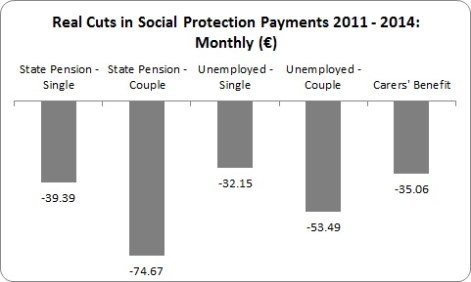
The Government’s failure to protect social protection
payments has resulted in substantial real
cuts (after inflation) in social protection payments. For a single pensioner, the cut is over €39
monthly while for a pensioner couple it is nearly €75. For the unemployed, it has been between €32
and €53 for single and a couple respectively.
Those on carers’ benefit have experienced a cut of €35 monthly. These all represent a real cut of 3.8 percent. This is substantial if you are on the poverty
line.
For households with children the cuts have been considerably
higher – especially given the nominal (actual) cut in Child Benefit.
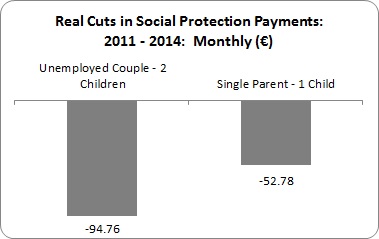
For an unemployed couple with two children, the monthly real
cut is €95 per month – or 4.8 percent; for a single parent with one child, the
cut is €53 per month – or 4.7 percent.
This hardly constitutes ‘protection’.
Unfortunately, we only have data up to 2011 but the
CSO’s deprivation rate gives us some idea of how people are being
protected:
- 42.4 percent of the unemployed are officially categorised as
‘deprived’ (experiencing multiple deprivation experiences) - 35.9 percent of those unable to work due to illness or
disability - 14.2 percent of single elderly living alone
- 52 percent of those living in local authority housing (‘Rented
at below the market rate or rent free’) - 56 percent of single parents
Regarding the latter, as this would include all single
parents, the deprivation rate among those without work, or working part-time,
would be even higher.
We don’t know the trend since 2011. However, we can reasonably assume that real
cuts in social protection payments, combined with cuts to public services (cutting
home-help services for the elderly, cuts in disability support) is likely to
put upward pressure on deprivation rates.
Increasing social protection payments is not the solution to
ending deprivation or poverty but it is a crucial element. How would unemployed households with two
children fare if social protection payments had been protected, if payments were
€95 higher per month than they are now?
They would still be under pressure; they would still be living below the
relative poverty line (nearly 12 percent below). But it would be better. And better is better than not better.
Could the Government have addressed this in the last
budget? Yes. Social
Justice Ireland shows that a small increase in social protection payments –
2.7 percent, or €5 weekly for a single person – would only cost €231 million in
gross terms. I emphasise ‘gross’
because, given the high propensity to spend of low-income groups, almost all of
this would be returned to the economy.
The Nevin Economic Research Institute estimates that, after factoring in
the positive impacts (higher consumer spending, higher employment as a result),
SJI’s proposal would cost only €126 million in net terms.
€126 million? That’s
less than 0.1 percent of GDP. It would
have effectively had no impact on the deficit.
And if the Government had introduced a modest wealth tax – along
the lines suggested by Tom McDonnell – the deficit would have decline even
more than currently planned (or enact any number of tax proposals that would
impact on high income groups such as capital tax increases, etc.).
So there was a choice.
The Government made theirs. They decided
to let the living standards of those mired in poverty and deprivation fall even
further.
They decided not to protect social protection payments.
 Notes on the Front
Leave a comment