
I am a great fan of universality. It binds people from all social constituencies
through shared public provision. It
pools risk on the insurance principle.
It removes public goods and services from private markets and puts them
where they belong: in public markets. And in the specific case of health services,
free primary health redirects demand from expensive tertiary (hospital) care
into more cost-efficient channels. In
other words, all pretty good.
The trick is how to roll-out free universal benefit. This is made all the trickier when we are
still in fiscal cutting mod. Resources
are tight and there is a great demand for other services, income support and investment. In such a scenario the over-riding principle
should be to
- Roll-out universality in a way that maximises social
benefits and economic efficiency
On this basis, the Government’s strategy fails. For instance, the Government originally
announced that the first stage of rolling-out free GP care would be to extend
fee GP cards to all 60,000 patients suffering from long-term illnesses. This was a sensible approach. However, this
seemed to hit a roadblock with the Attorney General claiming that extending
free GP care on the basis of need rather than income would be open to legal
challenge (this seems strange, especially as people with long-term illness get
free prescription medicine). While legislation
has been promised to rectify this, the Cabinet was told last May that it would
be up to 10 months before legislation could be introduced. This probably accounts for the other delay –
issuing free GP care to patients on the high-tech drugs scheme.
Ok, there’s a problem that will take time to rectify – though
extending free GP care to children also requires legislation. What would be the next best step? Extending the benefit to everyone in a certain
category (e.g. households with under-5s) regardless of income? I would argue there is a better course.
The means-tests medical card thresholds have not increased since
2006. This means that inflation has
eroded the value of the threshold by a considerable amount. For instance,
the threshold for a couple with one child is €15,834. This is gross, less income tax, USC and PRSI
with some income exempt such as Child Benefit and Family Income Supplement. Nonetheless, it is quite low. That threshold was established in 2006. If it has been inflation-indexed, that
threshold should be eight percent higher in 2014. This refers to the full medical cared – free GP
visits and prescription medicine (minus the prescription charge).
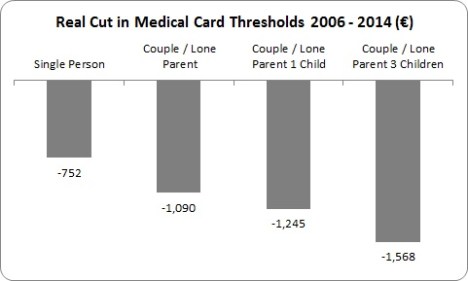
As a first step these real cuts (after inflation) could have
been reversed in Budget 2014. The great
advantage here would be that the full medical care – including prescription
medicine – would have been issued to tens of thousands of low-income
households.
If the strategy is to issue GP visit cards only (patients
would still have to purchase prescription medicine at market rates), then even
more low-income earners would benefit.
The thresholds
for GP visit cards are higher than the full medical card. For instance, for the family with one child the
full medical card threshold is €15,384.
For the GP visit card, it is €23,764.
How many people would benefit if the cost of rolling out
free GP care to under 5s (€37 million – though other estimates put the figure
much higher) were redirected into raising the thresholds for GP visit
cards? Difficult to say, but based on
the cost of providing GP visit cards to patients with long-term illnesses, my
own estimate is 150,000. The great
advantage of this is that it would benefit low-income earners with children up
to the age 16 and even older if they have no income or are in 3rd
level education without grant support.
In fact, if the Government wanted to provide greater benefit
for households with children (a reasonable policy) then they could have doubled
the threshold for children. If this were
done, then middle income households with one child (up to €33,000 a year) would
have benefited – and benefited for all children, not just those under five
years.
Raising the floor – or rolling out a universal benefit from
the bottom-up – is far more equitable than the current Government policy. This
could be a combination of raising income thresholds and extending the free
benefit to those groups with high and long-term medical costs. It is
also more economically efficient. If
low-income households have their medical costs subsidised by the state, then
the savings they make will more likely be spent in the consumer economy. For high income earners benefiting from the
free under-5s – the subsidy could just go into savings or spent on import-dense
goods and services.
But this wasn’t done.
There is considerable scepticism regarding the Government’s new policy –
not least, whether it will see the light of day. In particular, is the concern that it is
being paid for by withdrawing medical cards from those who need it. And that it wasn’t agreed until the midnight
hours a day before the budget – that doesn’t give people confidence, either.
This kind of thing gives universality a bad name.
 Notes on the Front
Leave a comment