
So, Fine Gael has caved in to Labour. There will now be only €2.5 billion in fiscal
adjustments (read: austerity), not €3.1 billion. A victory for the junior partner or a necessary
concession given the general austerity fatigue; regardless the reason, less cuts and
taxes. But how can we be sure? Given what has happened over the last two
budgets, I would urge caution.
Measuring a Government’s budgetary package used to be
relatively straight-forward. You just
added up the tax and the spending measures (whether they were increases or
cuts). They can be parsed in two ways – the
tax increases and cuts that hit in the calendar year and the total full-year
impact. The difference between the two
is that in many cases, a tax increase or a spending cut may come in during the
year, not at the beginning; this means that it may not be fully felt in the first year.
That’s why it is best to focus on the full-year yield of
budgetary measures. Here, I will focus
on current spending cuts. In Budgets
2012 and 2013, the Government claimed that it was cutting current expenditure
by approximately €1.5 billion in each – or €3 billion over the two years. How does this compare with what the
Government actually published in the Expenditure Reports for each budget?
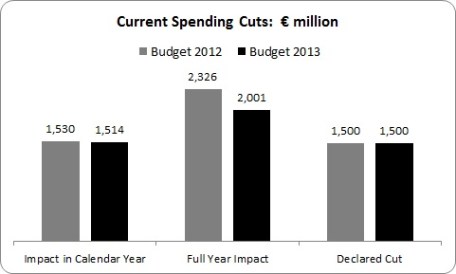
The current spending cuts announced in the budget came to
€1.5 billion in the calendar year. This
is the basis upon which the Government declared that their fiscal consolidation
was €1.5 billion in each year.
However, when you add up the full year impact, the amount of
cuts was higher. In Budget 2012, the
Government published current spending cuts of over €2.3 billion; in Budget
2013, it was €2 billion.
In other words, the Government has cut more than
they admitted to. In the last two
years they announced cuts of over €4 billion while claiming it was only €3
billion.
Of course, not all cuts were implemented: in the Health budget, charging private
patients the full cost of a bed in a public hospital and reductions in the
cost of drugs did not happen. However,
to balance this out a number of cuts were announced between budgets (e.g. cuts
to home-help hours).
The point here, though, is the presentation of the actual
numbers in the budget. The Government
used the calendar year impact when the cut should be presented on a full year
basis. They have been able to get away
with it since they have focused people's attention on the calendar year cost (and
because very few went to the trouble of adding up the full-year costs).
Does this matter or is it all a bit of number –grubbing? Well, it does matter. If the Government is actually introducing more
austerity measures than they are admitting to, it has a clear economic
impact. It also reflects on the
transparency of budgetary presentation.
There is also an impact on the ratio between tax increases
and spending cuts. For instance, some
Ministers claimed that last year the ratio between tax increases and spending
cuts was nearly 50:50. This is not the case
based on their own budgetary numbers.
In both years, taxation made up only a third of total
budgetary adjustments – even last year when it was claimed that taxation made
up nearly 50 percent of the total adjustments.
Maybe the fiscal adjustment in Budget 2014 will be closer to
€2.5 billion rather than the original €3.1 billion. But if the last two budgets is anything to go
by, it is imperative that we look at the actual budget numbers and don’t take
press releases and Ministerial claims at face value.

 Notes on the Front
Leave a comment