
In the run-up to the budget all the talk is of how many jobs
will be destroyed as a result of Government measures. Well, not really. But it should be. Ministers and Government backbenchers are
fond of quoting one measurement of employment that suggests 30,000 jobs
were created in the last year. Never
mind that this comes with so many caveats and represents ‘data-dredging’ (searching
for one or two stats that puts you in a good light regardless of the context). What they never, ever mention is that their
austerity measures are actually destroying thousands of jobs.
No one doubts that spending cuts and tax increases lowers
economic growth; this in turn lowers employment. The only question is how many jobs are being lost. I will summarise the estimates from the ESRI
and NERI, based on an adjustment of €1 billion (e.g. a €1 billion cut in social
protection payments, a €1 billion increase in property tax, etc.).
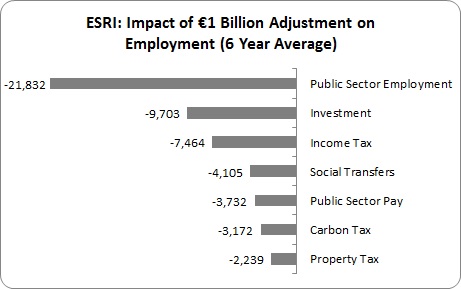
Not surprising, all measures destroy jobs. The biggest culprit is reducing public sector
numbers (this helps explain why cutting
public sector numbers actually increases the debt). The second biggest negative impact is
investment. The two adjustments that
have the least impact on employment are carbon and property tax. There are a few points to bear in mind:
First, the projection for investment is an
under-estimate. The ESRI does not
include the ‘supply-side’ impact (that is, the loss in employment from not
using the asset created by the investment – a road, building, telecommunication
network, etc.). According to the ESRI,
this under-estimate is ‘significant’.
Second, income tax has the third most negative impact. These estimates are an average of the impact
over six years. The impact varies over time. For instance, increasing income tax has only a
negligible impact in the first year it is introduced (reduces employment by
1,860). However, the deflationary
impact accelerates over the years so that by the fifth year the impact is
nearly five times that amount. I have
used the average.
Another feature of the income tax estimate is that it is
based on raising tax on all income groups.
It is reasonable to assume that if tax were increased on high-income
groups only (e.g. reducing tax reliefs) the impact on employment would be
lower.
NERI has also provided estimates.
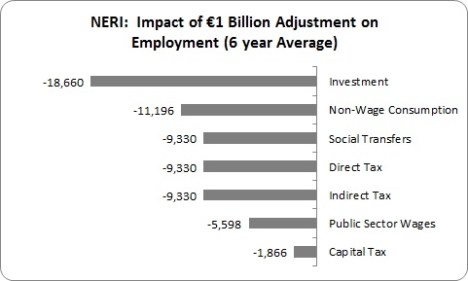
In the NERI estimates, investment has the most negative
impact. While it is in excess of the
ESRI estimate, it includes the supply-side impact. In second place, is non-wage consumption; NERI doesn’t estimate reductions in public sector numbers. This refers to contracts to the private
sector for goods and services that are used in producing public services (e.g.
purchase of blackboards, hospital beds, computers and erasers). A big difference with the ESRI is the impact
of social transfers; under NERI the impact is twice as negative. The least negative impact is capital taxes.
It would be tempting (and I’ll give in to temptation below)
to try to break all this down and estimate the job destruction that occurred in
the last two budgets. A problem with
this approach is that the categories above do not neatly fit into the budgetary
items. Further, NERI and the ESRI use different
categories and different methodologies so mixing them together is not wholly satisfactory. So let’s just
take a snapshot of the different measures the Government has introduced over
the last two budgets and see what NERI and the ESRI estimate:
- Investment: the Government has cut public investment by
approximately €1 billion in the previous two budgets. NERI estimates a loss of between 18,000 and
19,000 jobs; the ESRI estimates a loss of between 9,000 and 10,000 (but
remember, the ESRI admits their estimate in this category is an
under-estimate).
- Indirect Taxes
(VAT and Excise): the Government has
raised approximately €1 billion in this category. NERI estimated job loss: between 9,000 and 10,000.
- Social Transfers: the Government has cut social transfers by
approximately €1.3 billion according to the budget papers but some were not
implemented (the 7 year-old rule for single parents). So let’s call this an even billion. NERI estimated job losses: between 9,000 and 10,000. ESRI estimated job losses: 4,000.
- Reductions in Public
Sector Numbers: Since the Government
has taken office, public sector numbers have fallen by 12,000. ESRI estimated job loss: 14,500.
- Non-Wage Consumption: this has remained stable over the last two
years but in 2014 the Government intends to cut this by approximately €300
million. NERI estimated job loss: between 3,000 and 3,500.
- Property Tax: this
tax is being introduced in two phases. The
ESRI estimated job loss, when the full property tax is implemented next year:
between 1,000 and 1,250.
Taken together, these are substantial job destruction
figures. It is difficult to be precise –
not only because all the pieces of estimates and adjustments don’t fit; but we
are dealing with models and averages.
But a ball-park figure would be that Budget 2012 and 2013 combined
resulted in the destruction of between 43,000 and 57,000. In other words, if there were no fiscal
adjustments, there would be approximately 50,000 more people at work. And this doesn’t count all tax measures (e.g.
capital). That’s a lot of jobs. Even if this crude estimate is off by 25
percent –this is huge.
That’s why it is a bit galling to hear Ministers say they
are 100 percent focused on job creation (and releasing statements every time the IDA
and Enterprise Ireland announce a new project) when at the same time they are
destroying tens of thousands of jobs.
All fiscal adjustments impact on employment – even ‘taxing
the rich’. Smart fiscal management would
pursue adjustments with the least impact on employment while promoting job
creation through higher investment and more productive use of current spending. Unfortunately, there is a shortage of smarts
among our rulers.
There is all this debate about whether Budget 2014 will have
€3.1 billion adjustments or €2.8 billion or €2.5 billion. What a great diversion. What we should really be debating is how many
thousands of jobs will be destroyed by Budget 2014.
Based on the past two budgets, it will be a lot.
NOTE: I’d like to
thank the Nevin Economic Research Institute for forwarding me their
estimates. I understand they will be
publishing their full impact studies shortly.
 Notes on the Front
Leave a comment