

Come with me, my payee / To the sea . . . the sea of debt / I want to tell you / How much I owe you
Do you remember when we met? / That’s the day I went into debt / I want to tell you / How much I owe you
With apologies to Phil Philips but his great
song came to mind when I read this little stat in the Fiscal Council’s
latest publication, The
Government’s Balance Sheet after the Crisis: A Comprehensive Perspective
‘Ireland had the fourth highest debt ratio in the Euro Area in 2012,
whereas in 2007 Ireland had the second lowest ratio. (Only three Euro Area
countries had debt-to-GDP ratios in excess of Ireland’s at end-2012 according
to Eurostat estimates: Greece (156.9 per cent), Italy (127.0 per cent) and
Portugal (123.6 per cent).’
Well, I
guess that’s what happens when you bail-out insolvent businesses while at the
same time pursuing austerity policies that actually increase the debt. But I’m afraid it’s worse than the bald
numbers the Fiscal Council presents.
There are
different ways to measure debt – as a percentage of GDP, GNP, etc. But let’s measure it as a burden on people
– for its people who pay off debt. When
we look at
debt per capita this is what we find:
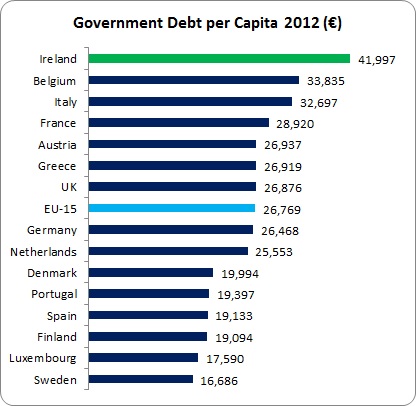
Ireland is
at the top, head and shoulders above all other countries – in particular,
Italy, Greece and Portugal which the Fiscal Council refers to as countries with
a higher debt when measured as a percentage of GDP. Why the difference?
Measurements
which use GDP as the benchmark can distort Irish data given that GDP is
flattered by the accounting practices of multi-nationals. For instance, when using Gross National
Income as the benchmark (which is equivalent to GNP) which removes
international flow such as profit repatriation, debt in Ireland is 143 percent
of GNI. This is the second highest, only
exceeded by Greece. But the fun doesn’t
stop there. The ESRI has found that even
our GNP/GNI is
inflated due to multi-national activities (undistributed profits of
headquartering multi-nationals). If this
was factored out, we’d be reaching Greek levels of debt.
We have to
be cautious with the above table. While
it shows Irish debt per capita as the highest in the EU-15, this doesn’t show
the capacity to absorb and repay debt.
For instance, I may have a high debt level but if my income is high, I
may be able to absorb it. Therefore, the
following shows the relationship between debt and income (GDP) per capita. Given that Irish GDP doesn't adequately
reflect the economy’s real capacity, I will use the Fiscal Council’s hybrid GDP
– a middle ground between two unsatisfactory benchmarks – GDP and GNP. In using this, I will further subtract that
portion of GNP that the ESRI estimates is inflated due to multi-national
accounting practices.

Ireland may
not be at the top – that prize goes to Greece – but we’re nearly there, ahead
of Italy and Portugal. We are an
incredible 75 percent above the EU-15 level of debt.
Many might
conclude that our debt is not sustainable.
In a rational world that might be true.
But this is Ireland.
Sustainability is not just an economic concept; it is a political one as
well. If people believe, however
reluctantly, that there is no alternative but to repay ‘our’ debts (‘our’
includes the debts of insolvent and non-existent businesses), then it will be ‘sustainable’. We will tax ourselves beyond levels which the
economy and households can afford. We
will suffer spending cuts – both nominal and real (i.e. after inflation) – beyond
any levels contemplated in Europe. We
will force the economy to become the handmaiden of debt-repayment. It can be done – provided you are willing to
suffer high levels of unemployment and deprivation, maintain the investment
crisis, and drive wages and incomes downward.
Unfortunately, there is a
political regime here in Ireland that wants to prove there is no debt that
cannot be repaid even if have to wreck livelihoods and
life-chances.
And people will be left to scramble for a life-raft, a buoy, a piece of driftwood –
anything that will keep them afloat in the sea of debt. But most of all, they had better learn to
swim.
NOTE: I will follow this up with a look at household debt. But for now, this is depressing enough.

 Notes on the Front
Leave a comment