
Are you getting tired of unsubstantiated claims that social
protection payments are a disincentive to taking up a job? Me, too.
These assertions pass for informed commentary on the unemployment
crisis, using crude calculations and even cruder assumptions about social
behaviour. Let’s throw some light on
this dismal debate.
It is claimed that welfare payments make up too high a
proportion of take-home pay from work, and that this is stopping people from
taking up work. This, in turn, is
helping to maintain high unemployment. This
is called the ‘replacement rate’. If you
earn €100 and social protection payments are €60, the replacement rate is 60
percent. If the replacement rate is too high, you get
disincentives. When this happens, you
have to do something (this usually means cutting social protection payments) in
order to reduce the replacement ratio.
Let’s examine the replacement rates from two years – 2012 and
2007. With the help of the Citizens
Information Board’s budget summaries and the TaxCalc calculator I will focus on a two-adult
household with three children since the main complaints re: welfare disincentives
usually focus on large households. We
will compare them with the household take-home pay on the minimum wage, along
with average take-home pay in the retail sector and the overall economy (one
work-income earner).
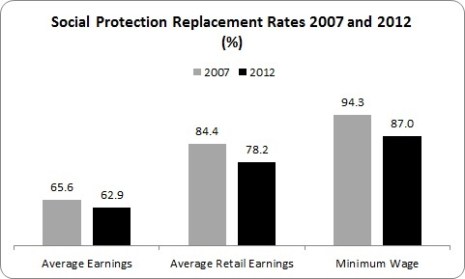
The replacement rates were higher in 2007 than they were in
2012. With average earnings, social
protection payments made up 66 percent of take-home pay in 2007; in 2012 they
made up 63 percent. There were similar
falls in the replacement rate for average retail earnings and the minimum
wage.
For all households, income from Child Benefit fell. Average work income flat-lined but net
take-home pay fell owing to higher taxation.
This was compensated by increases in the Family Income Supplement. Social Protection payments, excluding Child
Benefit, increased but this was mostly due to Child Dependent Allowances (adult
rates only increased only marginally).
Put those all through the mix and we find the replacement rates
falling.
The above excludes housing subsidies – notably, rent
supplement which creates real traps in the system. However, were we to include them the
replacement rate in 2007 would be even higher than in 2012. This is because the average rent supplement
paid has fallen considerably. In
2007 the average rent supplement paid was €6,554. In 2012, it had fallen to €4,819 – a fall of
over 26 percent. In addition, it should
be noted that only 11 to 12 percent of the unemployed received rent supplement,
so we’re talking about a small proportion.
.
So if the welfare disincentive argument is valid – that ‘high’
social protection payments are preventing people from taking up work –we should
have seen this problem in 2007 since replacement rates were higher than they
were last year. We should have seen a
situation of relatively high unemployment and vacancies going unfilled. But what do we find instead?
- Unemployment rate in 2007:
4.7 percent - Unemployment rate in 2012:
14.7 percent
In 2007 the long-term unemployment rate was 1.4 percent; in
2012 it was over 9 percent.
So when the replacement rate was higher we nearly had a full
employment economy with one of the lowest long-term unemployment rates in the
EU. Now that replacement rates are lower
we have massive unemployment, both short and long-term.
One could be cheeky and suggest an alternative co-relation –
the higher the replacement rate, the lower the unemployment rate; therefore, to
create incentives to work we should increase social protection payments. But that would be as invalid as the opposite
claim. There are far more important factors
in creating high unemployment – namely, the lack of jobs. We’ll look at this below but first let’s do
some international comparisons.
European Comparisons
Let’s
compare the replacement rates for EU countries with much lower unemployment
rates than ourselves: Austria (4.3
percent unemployment), Netherlands (5.3 percent), Germany (5.5 percent),
Belgium (7.6 percent) and Finland (7.7 percent); Ireland had an unemployment
rate of 14.7 percent and Spain’s rate was 21.7 percent. If the disincentive to work argument works,
we should see those countries with relatively low unemployment to have much
lower replacement rates than Ireland and Spain.
What do we find?
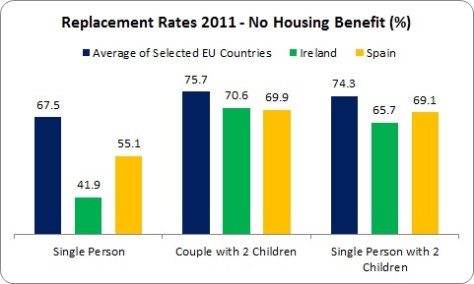
We see that, with no housing benefit (e.g. rent supplement),
Irish and Spanish replacement rates are below the average of the selected EU
countries – in the case of the Irish single person, substantially so. When we look at replacement rates including
housing benefit we find:
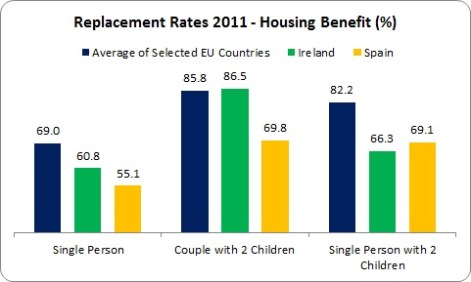
With housing benefits – remembering that only 11 percent of the
Irish unemployed receive rent supplement –replacement rates are still below
selected EU countries, with the exception of a couple with two children which comes
in at average. Again, Spain lags behind
other EU countries.
None of this shows that ‘high’ replacement rates are an
impediment to taking up work – provided that work is available. And that is the real issue.
Simple Math
There are two simple formulations that undermine the welfare
disincentive argument. First, there are
32 unemployed for every job vacancy in Ireland. Cut social protection and living standards
of jobseekers all you want and this will not reduce that dismal ratio. In fact, it is likely to increase it as
cutting demand will mean even less consumer activity in the economy. The Nevin Economic Research Institute shows
the vacancy rate in other countries which you can access
here (page 33).
And here’s another way to explain unemployment. The last Quarterly Household National Survey
showed that there were 2.171 million in the labour force. There were 1.870 million in employment. Subtract the latter from the former and you
get 301,000 unemployed. That’s the
surplus. How does cutting the incomes of
the surplus increase the number in employment?
This is something that the school of welfare disincentives fail
to address.
The Real Work
How easy it is to look at a problem and say ‘cut it’. High unemployment? Cut wages, cut social protection. It saves one the hard work of addressing the
real problems – namely, the low demand for labour. But even if we focus on the social protection
regime itself, there is still the hard work of putting forward concrete
proposals. One could start with the Citizen
Information Board’s submission on the topic. They highlight a number of key areas where
work, social protection and taxation interact to create income, poverty and
unemployment traps – particularly in the areas where people are trying to
combine part-time / atypical work and social protection.
Working hours
criteria: unemployment payments for
part-time workers are calculated according to days, rather than hours. Someone who gets 10 hours’ work per week is
treated differently if it the work is spread out over five days as opposed to
two (in the former, they get no social protection payment).
Rent Supplement: the withdrawal of Rent Supplement for anyone
working in excess of 30 hours per week can act as a trap. Some kind of transition period – a tapering
over time or over hours – would facilitate this, as would an earnings disregard.
Family Income
Supplement: people must work at
least 19 hours a week to be eligible for FIS.
This, along with the administrative delay of up to several months before
payment is approved, discriminates against part-time work.
Universal Social
Charge: income below €10,036 is
exempt from the USC. But once it exceeds
that threshold, the USC is charged on all income – creating a step effect. This was introduced by the current
Government.
In-work costs: costs as travel and, especially childcare,
makes it costly to take up work. Travel
costs range between €15 and €25 per week, while childcare costs are one of the
highest in the EU.
Co-habiting couples: currently cohabitating couples are treated as
a couple for the purposes of social protection but on moving to employment,
cohabiting couples are not jointly assessed and do not benefit from the
‘married persons’ tax credits system.
Administrative Delays: Delays in processing applications means
people have to manage on inadequate income – below what they were getting on
social protection – while awaiting their payment. This makes it difficult for people to take up
temporary work.
These and a myriad of other issues impact those in low
incomes. People want to work. When it is available, they’ll take it. Even if this means they suffer some of the
difficulties above. Yet the debate is
dominated by those who, ignorant of what life is like at the cutting edge of
unemployment, poverty, atypical work and social protection regulations, make
sweeping comments about ‘disincentives’ and call for social protection payments
to be cut.
What Is Never
Mentioned
As this post has gone on long enough, I won’t go into too
much detail about the flip side of the equation – are social protection
payments too high or are wages too low?
If one wants to ‘make work pay’,
then we need decent wages. Again, just
some quick comparisons in two low-paid sectors – how much of a pay increase (in
PPP which removes living standard and currency variations) would Irish
workers need to reach different EU averages.
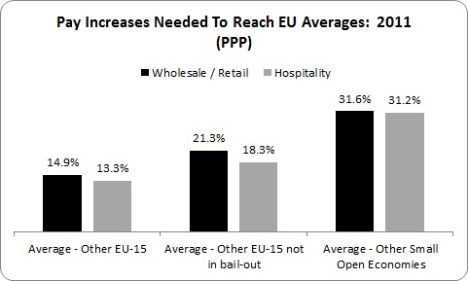
Ireland lags well behind EU averages in both main low-paid
sectors. In the wholesale / retail
sector, Irish workers would need a pay increase of between 15 and 32 percent
just to reach the average of other EU-15 countries and small open economies
respectively (the other small open economies, which is our peer group as they
are small economies reliant on the export sector, are Austria, Belgium,
Denmark, Finland and Sweden).
In the hospitality sector – hotels, restaurants and pubs –
Irish workers would need similar increases to reach the EU averages: 13 to 31 percent.
So the question that should be put on the agenda is whether
wages are too low, especially in the low-paid sectors. This is all the more urgent when one notes
that over 27 percent of households with one income suffer
multiple deprivation experiences.
* * *
Social protection payments are not a disincentive to
work. Lack of jobs is a disincentive to
work. If we want to help people – rather
than hector or label them (e.g. ‘life-style choice’) – we need to raise the
demand for labour in the economy , raise wages in the low-paid sectors and
create a social protection/taxation system that makes it easy for people to
take up work. We need to provide
supports – especially affordable childcare – rather than engage in comfortable
armchair lecturing.
And we need to a fact-based debate. That would be of benefit if only to spare us so
much nonsense about welfare disincentives to work.

 Notes on the Front
Leave a comment