
In the run-up to the budget all manner of proposals are
being put forward –tax measures, spending cuts.
We debate what sacrifice this or that groups can make to bring us to
the bail-out targets. There is no end of
combinations and computations. But the
one thing that is totally off the table – the one thing that we should never,
ever mention – is what contribution the business sector can make to repairing
the public finances. Pensioners, the
unemployed, low-paid, families – we debate the different ways they can make
continued sacrifices. But the business sector has been ring-fenced, protected,
safe-guarded.
The following estimates what contribution, in terms of tax
and social insurance revenue, the Irish business sector could make if it made
the same contribution as the average business sector in the EU-15 – and how
little Irish business actually does contribute.
Corporate Taxation
Never mind nominal tax rates – it is the effective tax rate
that matters; the percentage of taxation on profits when reliefs, allowances
and exemptions are taken into account. Tom
Healy, Director of the Nevin Economic Research Institute, has an important post
on this subject – pointing out that there are different benchmarks in assessing
the effective tax rate. For the
purposes of international comparison, I will use two estimates: net operating surplus and net entrepreneurial
income.
Net Operating Surplus: this traditional measure of profitability is
the amount of value-added left to companies after payroll costs and consumption
of fixed capital (decline in the value of fixed assets); in short, sales minus
costs. This is from Eurostat – here and here:
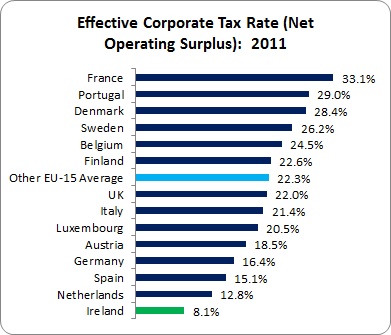
Ireland, unsurprisingly, is at the bottom of the table. On this basis, the Irish business sector
would have to pay an additional €6.7 billion into the Exchequer to reach the
average of other EU-15 countries.
Entrepreneurial
Income: this is probably the better measurement. The CSO
describes it as ‘. . . a more
comprehensive measure of corporate profitability’. Here is Eurostat again:
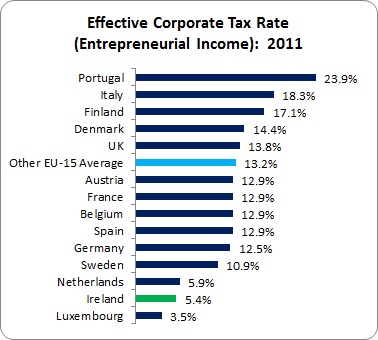
In this tabulation Luxembourg beats Ireland to the bottom (it’s
worth noting that the EU’s investigation of corporate tax practices have
targeted the three countries at the bottom – Netherlands, Ireland and
Luxembourg). On this basis, the Irish
business sector would have to pay an additional €5.5 billion to reach the
average of other EU-15 countries.
To summarise this section – the Irish business sector would
have pay between €5.5 and €6.7 billion just to reach EU corporate tax averages.
Social Insurance
The second category through which employers contribute to
public finances is employer’s social insurance (or PRSI in Ireland). Here there is more certainty as to the actual
effective contribution rate.
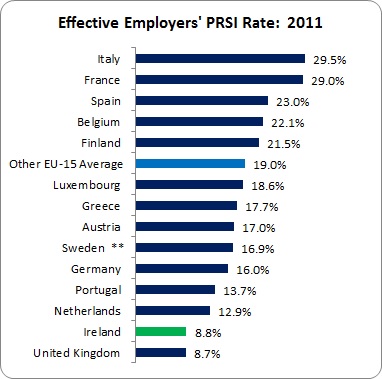
Again, Ireland is a bottom-dweller, sharing this position
with the UK. Employers’ PRSI revenue
would have to more than double to reach the average of other EU-15 countries –
an increase of €6.4 billion.
* * *
If we were an average EU economy, if we had an average
business sector, if we had an average balance of taxation revenue – then we
should expect between €11.9 and €13.7 billion more in tax and social insurance revenue
from the business sector. But we don’t
have an average economy or business sector.
The main problem is that much of the corporate profits that are taxed
here are not generated here – they are ‘imported’ from other economies to take
advantage of our low tax rate (but do not, under any circumstances, confuse
this with being a ‘tax haven’ – it is merely ‘tax efficient’; and a gold star
to anyone who can explain the difference).
In any event, we don’t ask the business sector to assist in
the fiscal crisis. In fact, we give them
even more subsidies. In the last budget
there was an extension of the Employment and Investment Incentive, R&D tax
credits, relief for start-up companies, and real estate investment trusts.
The Irish business sector is not a partner in the drive to
repair our public finances. It exists
outside and apart. Repairing public finances is
for little people. Even when a small
increase in the corporate tax rate –2.5 percent – and a small increase in
employers’ PRSI – 1 percent – could, together, raise close to €1.5 billion;
even when after such increases the Irish business sector would still be at the
bottom of the corporate tax and social insurance tables; even this small
contribution cannot be countenanced.
Now, how about cutting even more home helps. And those disability groups – they have more
money than they know what to do with.
And, of course, those darned social protection payments. Who needs the help of the business sector
when there are so many who can take up even more of the burden?
Bring on Budget 2014.


 Notes on the Front
Leave a comment