
Well, well, well. You
know that policy of reducing the number of public sector employees? Nurses, Gardai, civil servants, local
authority workers? The Government trumpets the success of this
downsizing: since late 2008, public sector numbers have fallen by nearly 30,000. This has saved, according to Ministers, a lot
of money: the Exchequer pay bill
(excluding pensions) has fallen by €5 billion; though some of this is due to
pay cuts. Leave aside the impact on
public services – fewer people offering services with less resources; just
focus on the fiscal side of things. It
would appear that public sector downsizing is successful.
There’s just one catch:
it is actually driving up the debt.
Readers of this blog will be familiar with the multipliers
that the ESRI has produced in the past – estimating the impact of different
fiscal measures (tax increases, spending cuts) on the economy, employment and
public finances. Now the ESRI has
produced their third impact study: ‘The HERMES-13
macroeconomic model of the Irish economy’.
In many respects, they confirm their previous results. But they add a few new wrinkles. One of them is the impact on the general government
debt. And when it comes to reducing the
number of public sector employees, they found that doing such a thing actually
increases the debt.
First, let’s go through their numbers. They
assess the reduction of public sector numbers in order to ‘save’ €1 billion in
2013 (in previous studies, they assumed this would mean a reduction of 18,000
employees). Then they looked at the
impact of this measure on a range of indicators – GDP / GNP growth, consumer
spending, employment, deficit, etc. This
is what they found for the impact on the government debt.
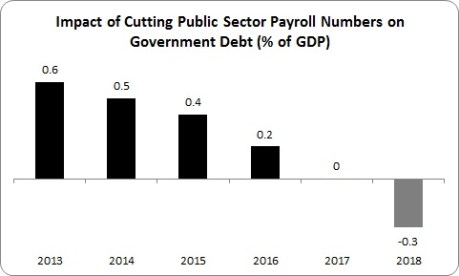
As seen, the debt rises in the first year – by 0.6 percent
of GDP. By the fourth year, the debt is
still higher. Only in the sixth year
after reducing public sector numbers does the debt start to fall.
The austerity brigade might point to this debt reduction in
the long-term and, say, ‘well, yes, it does increase the debt in the short-term
but in the long-term everything comes right.’
However, there is a real sting in the tail; actually, two stings.
The long-term reduction in the debt only happens because of
emigration. Indeed, of all the fiscal
measures (income tax increase and cuts in public sector wages, employment,
social transfers and investment), the cut in employment has the highest
negative impact on emigration.
‘If the external
environment were to continue to be very difficult such a level of emigration
might not materialise resulting in higher unemployment in the medium term.’
The second sting is that when public sector numbers fall,
wages fall. This
is because lower employment in the economy creates downward pressures on
wages. In the ESRI model falling
wages is a good thing – it makes us more competitive and, therefore, marginally drives up exports in the long-term.
Personally, I don’t buy this (competitiveness cannot be reduced to wages
and, in any event, wages make up a tiny proportion of total costs in the export
sector).
So this is what we have.
Cutting public sector number drives up the debt. Over the long-term, the debt falls only if
more people are driven off this island looking for a job and if the decline in
wages increases exports. Emigration and
wage cuts: that’s a pretty dismal
calculus.
Why does cutting public sector employment result in a higher
debt? It seems counter-intuitive; after
all, spending on the public sector pay-bill falls. S why doesn’t the debt fall? Let’s focus on two areas. First,
is the combined impact on the economy and the deficit.
Between 2013 and 2018, according to ESRI estimates, the
deficit only falls by 0.2 percent of GDP (a pretty fractional amount given that
last year the underlying deficit was 8.6 percent). However, GDP falls on average by over 0.7
percent – in other words, by over three times the amount of the deficit
fall. So, the deficit falls (marginally)
but the economy falls much further – the classic ‘spinning the wheels in the
deficit ditch’.
Second is the impact on employment – a major driver in the
deficit. The ESRI estimates that in the first year of the cut, employment falls
by 1.2 percent. In 2013, this would have
equated to 22,000 jobs. If the €1 billion cut in public sector
employment equates to 18,000 employees, this means that approximately 4,000
private sector jobs are lost. Again,
this is not a surprise – removing 18,000 jobs from the economy reduces consumer
spending which, in turn, hits private sector employment. In short, for every 100 jobs removed from the
public sector, employment falls by over 20.
So, there you have it:
the economy falls faster than the deficit while losses in public sector
employment leads to substantial private sector job losses. That’s why the debt burden rises. And the only way this can come right in the
long-term is if emigration rises higher than what the ESRI is already
projecting and private sector wages fall.
Next time a Minister is trumpeting the success in cutting
public sector employment as proof that the Government is taking the hard
decisions to correct our public finances, hopefully the interviewer will ask:
‘But Minister, estimates show that you’re only increasing
the debt. How does increasing the debt
count as a success? How does making the
wrong decision count as a hard decision?’
I really would love to hear the reply.


 Notes on the Front
Leave a comment