
First, the good news:
there is no need for spending cuts in Budget 2014. This should come as a relief to people on
social protection, users of public services, people reliant on public
investment for work and public sector workers. This should also come as a relief to everyone
in the economy. As Friends
First states:
‘The greatest stimulus that Government could now give the
Irish economy would be to indicate an easing of the fiscal austerity. This
would have a massive impact on consumer and business confidence.’
Too true. Why are
spending cuts unnecessary? First, let’s
recall the Minister for Finance’s comment on The Week in Politics:
‘There are options emerging.
We have to make targets in the programme. The ultimate target is to get the deficit
below 3% in 2015.’
So the ultimate target is 3 percent by 2015. What would happen to the deficit if there
were no spending cuts? We can use three
different models to make what can only be approximate estimates – from the ESRI,
the Nevin
Economic Research Institute and the Department
of Finance. They all show similar
results (notes on these appear at the end of this post).
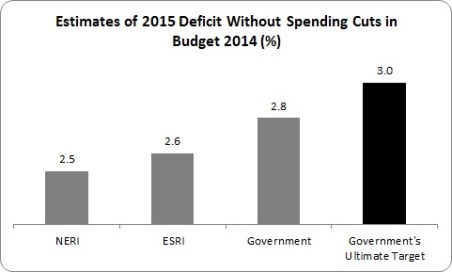
It is assumed that €1,450 million in current spending cuts
will not proceed (the Government targets €1,900 million in current spending
cuts but there €450 million in carry-overs from Budget 2013). But, of course, that’s not €1,450 million
added to the deficit. Reversing these
spending cuts – which amounts to a type of stimulus – would increase GDP, consumer
spending and employment. When these are
factored in, the deficit rises by less than the headline spending cut. And all the data we have available is that the Government's ultimate target will be reached without spending cuts.
What about the positive impact that Friends First
mentions? Here the data is sketchy but
we can make some estimates. In terms of
consumer spending:
- The ESRI data suggests consumer spending could rise by €850
million in 2014 and €1,250 million in 2015 if there were no cuts.
- The NERI data suggests consumer spending could rise even
further – by up to €1,700 million in both 2014 and 2015.
In terms of employment the NERI data suggests that job
numbers could rise by over 10,000 if there were no spending cuts.
So there is strong evidence that the Friends’ First
assertion is correct – that the best stimulus would be to reduce
austerity. But isn’t that always the way
– not doing the wrong thing can produce better results.
That’s the good news.
By not proceeding with the Budget 2014 current spending cuts there will be higher economic growth, more
consumer spending and more people employed – and all this without undermining
our deficit targets.
Now, for the bad news.
The spending cuts are likely to go ahead. The Government’s fiscal policy has been on
auto-pilot ever since they entered into Government when they essentially took
over Fianna Fail’s fiscal policy and put a FG/Lab logo on it. Labour may succeed in clawing back some of
the spending cuts but we will have to endure an inane debate about whether the benefits
from the Anglo-Irish promissory note deal should be spent on investment, or
cutting taxes or easing off on spending cuts (a subject for a subsequent post). However much Labour may succeed it is highly likely that we will still get
substantial cuts in next year’s budget – cuts in public services and social
protection.
But let’s end this post with some positive news again – the spending
cuts are not inevitable. To stop the
austerity locomotive, however, we need to get organised and build a broad
coalition. Already, Social Justice
Ireland has produced a credible and pragmatic pre-budget submission, showing
that not only can we avoid spending cuts, we can actually start to reverse the
cuts over the last few years. Claiming
our Future is gearing up for a campaign on similar ‘no-spending-cuts’
platform. It is already official policy
of ICTU to oppose overall spending cuts.
And UNITE will be holding a pre-budget seminar on July 11th,
outlining its opposition to further spending cuts.
We have the makings of a broad-based coalition of civil society
groups. Now we have to actually put it
together. If we do, things might start getting a little bit better.
* * *
NOTES
The ESRI estimates are based on Government consumption
multipliers excluding non-wage (procurement contracts to the private sector)
and social transfers – the ESRI has not published data on these categories.
The NERI estimates are based on deficit multipliers
published in their recent Quarterly Economic Observer. I would like to thank NERI for supplying the
additional data on consumer spending and employment.
Government data is based on their debt sensitivity analysis
contained in their Medium Term Fiscal Statement – however, they do not distinguish
between tax and expenditure adjustments.
All estimations are my own, based on the data available.
 Notes on the Front
Leave a comment