
Ministers are fond of telling us that we are 80 percent through
the dark austerity forest. Soon, maybe
within a couple of years, we will enter into the light where all will be well
and normal fiscal policy can be resumed.
Just one more push and austerity will be no more. Should we put a lot of faith in this? I would recommend caution – extreme caution.
The Government has published a long-term scenario –
stretching out to 2019. This builds on
the projections up to 2016 in the recent Stability Programme Update. The Government is at pains to state that this
is an illustration:
‘Again it must be
stressed that this is purely an illustrative scenario.’
They even underlined it.
Yet, it is consistent with the Government’s SPU projections and it is
certainly consistent with reports
of a new plan being developed by the Minister for Finance.
‘The State’s
anticipated exit from the bailout this year will not mean a relaxing of
austerity targets as Mr Noonan hopes Government will approve a fresh regime
with firm timelines similar to the EU-IMF-ECB programme.’
Minister Richard Bruton was also giving
a warning:
‘Mr Bruton rejected the accusation that the public had
expected the end of the bailout term would signal an easing of austerity by
saying no “crock of gold” was available to the Government.’
Mr Bruton suggested that this situation would continue for
some time.
So it is worthwhile to look
at the Government’s ‘purely illustrative scenario’ as there is a very good
chance it will morph into the ‘only scenario’ (TINA will become TIOOS – There is
Only One Scenario). Let’s look at primary public expenditure – that is,
public expenditure excluding interest.
This identifies how much money will be spent on public services, social
protection and investment. I have used ‘real’
expenditure – that is, expenditure after inflation using the GDP deflator (the
economy wide inflation indicator).
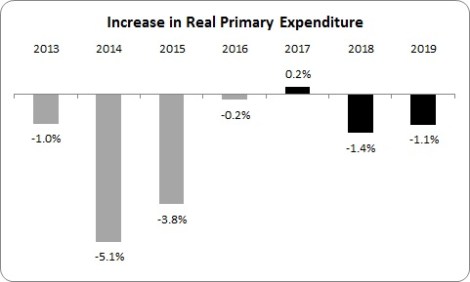
As seen, primary expenditure is expected to fall by nearly 9
percent over the next two years. From
2015 on, primary spending still continues to fall – by 2.6 percent in real
terms up to 2019 despite the Government pencilling in GDP growth of
approximately 12 percent during this same period.
But it gets worse. In
many areas public spending will rise automatically due to demographic
pressures. For instance, the number of
pensioners will increase so that even if pension payments remain frozen,
expenditure will rise. We should also
allow for a rise in demand on health services with this aging demographic. And in education, we will have to spend more
just to accommodate the continuing rise in our student numbers.
In other words, we will have to spend more on pensions,
health and education just to stand still. When this is factored in, there will need to
be additional cuts in other expenditure – in other public services, social
protection programmes and investment projects.
We are heading into a period of semi-permanent
austerity. Why, if by 2015 we have reached
the Maastricht target and when employment and economic growth will continue to
reduce deficit and debt levels? The
Government gives two clues. First:
‘Ireland is on track to correct its excessive deficit by
2015. Thereafter, the public finances in Ireland will no longer be subject to
the corrective arm of the Stability and Growth Pact (i.e. the Maastricht
guidelines) but subject to the requirements of the preventive arm and the
Treaty on Stability, Co-ordination and Governance (the ‘fiscal compact’).’
Ah, the Fiscal Treaty; remember those debates – how Government
ministers insisted that compliance with the pact would not necessitate further
austerity? We climb one hill only to
find there are more hills to climb.
Second, the Government seems determined to drive the budget
balance down to zero and then into surplus.
In other words, we will be taking in more money than we are spending by 2019. Now there’s nothing wrong with a balanced
budget at the appropriate time. But the
Government’s scenario estimates (and to be clear, this is not a projection)
that unemployment will be 11 percent.
How could anyone imagine any scenario where you run a budget surplus
with double-digit unemployment?
Is a balanced budget necessary to reduce debt per the fiscal
treaty? No – this is an issue we will
revisit in a subsequent post.
This is the future that some Government Ministers are
planning. After destroying our social and economic
infrastructure with irrational austerity policies, what is next? Continuing austerity amidst the ruins.
That’s the current scenario – unless we work for something
different; different than what has happened in the past, and different than
what is being planned for us in the future.

 Notes on the Front
Leave a comment