
As a prelude to a more detailed discussion
about the household debt crisis in subsequent posts, I’d like to present a few
graphs that should become central to the debate. They come from the data in the Department of
Environment’s Housing Statistics. The
first measures the growth of average wages between 1991 and 2007 which covers
the period of the boom years.
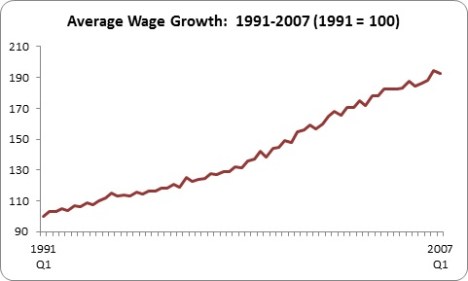
In this period, wages grew by 92 percent (seems like a lot
but when inflation is factored in wages grew by about 30 percent, or less than
2 percent annually in real terms).
Now let’s overlay the growth in house building costs.
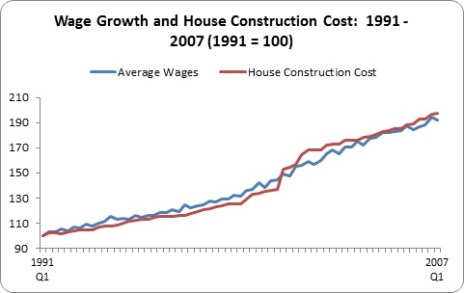
Interesting. The cost
of building a house rose at almost exactly the same pace – 98 percent.
Now let’s overlay the growth in house prices.
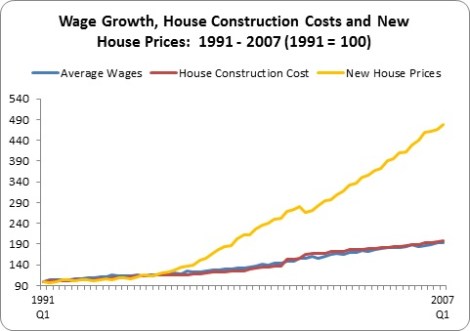
Hmmm. House prices
rose at the same pace as building costs and average wages up to 1996. After that the gap widens –
exponentially. Over the entire period
new house prices rose by 379 percent.
We tend, as shorthand, to blame the speculators, regulators
and financial institutions. And, yes, they were getting up to some pretty wild
and crazy stuff. But Shane Ross reminds
us – in ‘The Bankers: How the Banks Brought Ireland to its Knees’ – that there were a number of other vested
interests involved: realtors, mortgage
brokerage firms, stockbrokers, development-landowners, professional
associations, and the media – especially those sections which came to rely on
vast property advertising revenue. In
other words, there was a whole golden circle (remember that phrase?) that not
only enthusiastically promoted the property boom but drove an entire social
discourse around the economic and social virtues of the property market.
I don’t want to graph you out but here’s one that puts the
household debt crisis in perspective.
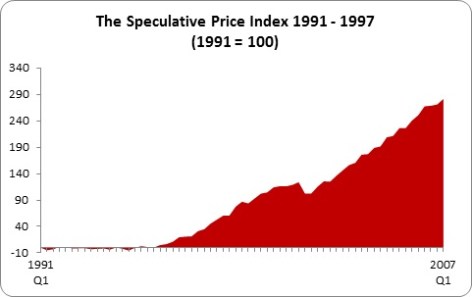
This represents the gap between new house prices and
building costs. Calling the entire gap
‘speculative’ might not be fully correct.
After all, there were demographic pressures – a younger population,
changing household formations, etc.
However, this would not account for the vast bulk of the price increase.
So what does all this mean for the debate today?
First, household debt did not become a crisis because people
‘went nuts’ buying houses without any regard to anything. It was
a systemic crisis – deeply rooted in the base of the political economy. Faced with this systemic phenomenon people
had two choices when purchasing shelter.
They could either take on a lot of debt buying a house, or they could
travel far away from work to buy a house they could afford (adding transport costs
and losing home-time for their efforts).
People’s behaviour did not cause
the property boom, it was merely a response.
They did not and could not control the price of housing – that was
driven by a runaway market manipulated by a golden circle of myriad interests.
And there were no substitution goods. Renting in the private sector was not an
option for most household types as this sector was was woefully under-developed.
Second, the household debt crisis did not arise through the
normal functioning of the ‘market’. As
we saw above, house price ncreases were consistent with average wages and construction
costs in the period between 1990 and 1996.
Builders weren’t losing money during this period. They weren’t building and selling houses for
philanthropic reasons. They were making
profits and employing workers. But the
speculative gap arose because the normal functioning of the market was
perverted. How do you think financial
institutions make a living? They earned
profits by loading households with debt.
A number of interests made a lot of money with the complicity of
Government policy (tax reliefs, tax cuts, lax planning regulations,
boom-incentivising development fees for local authorities, etc.) and
irresponsible financial regulation.
The household debt crisis is a political and social
issue. It is not – and let’s be
absolutely clear – it is not an issue of individual profligacy or household
irresponsibility. That people get into financial trouble through imprudent
conduct happens all the time – but to suggest that that the property crisis was simply the aggregation of individual financial recklessness is merely a
self-serving attempt to shift blame.
Yet we now frame the debate – and the new insolvency regime
– in terms of ‘sin’. People ‘sinned’
during the boom period, ‘over-extending’ themselves, buying a house. They must now purge their sins through five
years of below-poverty line existence – a process that involves the consent of
the very financial institutions which produced the crisis in the first place.
There is one word for all this: perverse.
There’s another word for this:
obscene. Not only do tens of
thousands of households suffer from arrears or the fear of arrears, the economy flat-lines
under the rule of the financial moral-police.
There is only one rational and equitable solution: get rid of the debt, write-it down, consign
it to oblivion. That is the starting
point for recovery. And if anyone dares
mention ‘moral hazard’ I’m calling in the Hulk to do some intellectual
slum-clearance. After paying off
bondholders and creditors, after bailing out insolvent institutions, the notion
of moral hazard is a tasteless joke.
How we do this is a major challenge which I will come back
to in subsequent posts. But the
fundamental starting point is to frame the issue properly. Otherwise, we will be frog-marched into a
limited range of solutions that places the burden in the wrong place.
With banks still in a dark place, with Government finances
in a similar state, we will have to think and construct solutions outside the
box – and in particular, the debt box that t has trapped so many people in.
This is the box we have to dismantle to help all of us get
back on the road to recovery.

 Notes on the Front
Leave a comment