
The CSO release two sets of data yesterday which shows show
why we are into a period of what Tom Healy, Director of the Nevin Economic
Research Institute, described
as ‘stable stagnation’.
First up is the Retail
Sales Index, which monitors the level of activity in the retail sector
(both volume and value). This is one
indicator of the health of the domestic economy.
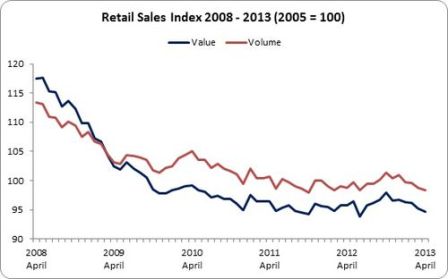
As seen, the Retail Sales Index has been stagnating since
early 2011 – going up a bit, going down a bit.
In the second half of last year it looked like the Index was recovering. Volume growth between June and December rose
by nearly 3 percent. But since December, the Index has
fallen every month. There was some hope
of recovery in April, after the torrid weather in March but instead we suffered
another fall. Indeed, last month was the
third worst month since the crisis broke.
Now let’s turn to the Earnings
and Labour Cost Survey which measures earnings per week and employment
(which excludes self-employment). Turning first to earnings:
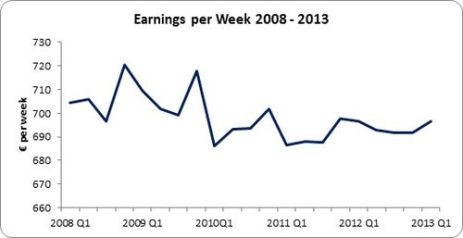
Again, earnings have remained broadly the same since late
2010. One has to be careful in this
measurement as we have to consider the ‘compositional effect’. For instance, if in manufacturing lower-paid
jobs are lost (as in the domestic sector), then what remains is higher
paid. The average, therefore, may show
an increase in earnings but actually there may have been no increase for the
people still working. Nonetheless,
earnings are trundling along at just below €700 per week.
It should also be noted that while earnings are not falling
(at least not as they were in the beginning of the crisis) a flat-line still
suggests a fall in real, after-tax incomes.
For instance, in the last year average weekly earnings fell by 8 cents. However, inflation in 2012 ran at 1.7
percent. So wages, after inflation,
fell. Then there were the
last two budgets – household charge, property taxes, abolition of the PRSI
allowance, cuts in family-income support, etc.
So after the toll of inflation, people’s pockets are hit again – driving down disposable income further.
And employment – excluding self-employment?
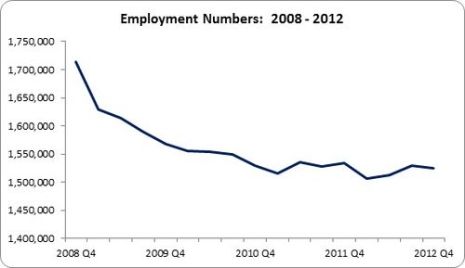
With data only going up to the final quarter of last year this,
again, shows numbers stagnating since late 2010. In fact, in 2012 employment in the total
economy fell by over 10,000 compared to 2011.
On a 4th quarter to 4th quarter basis, employment
fell by 9,500. We will get a better
insight into how things are going overall on Thursday when the CSO produces its
National Household Quarterly Survey for the first quarter of this year which
will include self-employment and precarious employment (i.e. under-employment).
So what do we have here?
Stable stagnation. Why are retail
sales stagnating? Because employment and
earnings are stagnating – and in the case of the latter, actually falling after
inflation and budgetary measures.
I recall hearing a Government Minister saying some weeks ago
that it was hard to explain ‘macro-economics’ to people. Well, no actually – people do get it. Ask anyone a simple question: will retail sales rise when real wages are
falling and employment is stagnating (never mind the little inconvenience of
paying off debts)? You’ll get a
unanimous no. In fact, people would be
surprised that anyone would ask such a dumb question.
People do understand the simple equation: X + Y (where both are flat-lining) = S (stagnation)
The real question is: does the
Government?
 Notes on the Front
Leave a comment