Notes on the Front

Commentary on Irish Political Economy by Michael Taft, researcher for SIPTU

Treasure Ireland

We are constantly assured (warned) that ‘everything is on
the table’.  All manner of tax increases
and spending cuts are being considered, and none are ruled out in principle.  So, goes the script. There is one issue,
however, that is not on the table.  It is
not even in the room.  It is not even in the
house or lurking around the grounds.  And
that issue is the corporate tax rate.  Why?

If we increased the corporate tax rate, this would undermine
our ability to attract foreign direct investment.  This, in turn, would result in fewer jobs
being created and put current jobs at risk; further, it would lower exports
which would skewer our balance of payments. 
All that value-added and economic activity would be jeopardised. 

Before we confront this argument, let’s first look at how
successful multi-nationals (MNCs) are in racking up profits in Ireland (also, this
analysis from Michael Burke
is also worth a read).  From this, we might get a sense of how
sensitive they would be to an increase in the corporate tax rate. For, in truth,
they
are really really racking up the profits
.

 
MNC 1

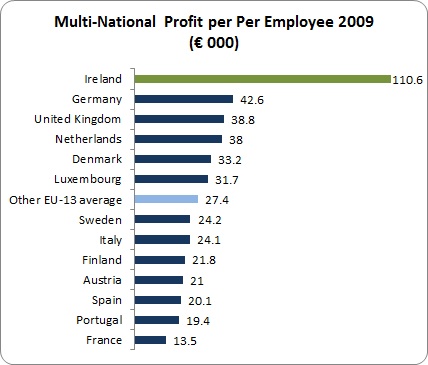
 Ireland is not just a league-leader, it is off the
chart.  MNCs here make more than four
times the profit per employees than the average of the other EU-15 countries
reporting (no data for Belgium or Greece). No wonder more and more multi-nationals
are making Ireland their home.  It should
be noted that this Eurostat data does not include the financial sector so the
massive profits being made in the IFSC are not included.  Nor does the above include taxation – we’ll
come to this later.

Not only are MNC profits high in Ireland, they are
resilient.  2009 was the year that saw
global profitability fall.  But not in
Ireland.  Whereas in 2009 profits fell in
the other EU-13 countries by an average of 17 percent, in Ireland they fell by
less than 1 percent.

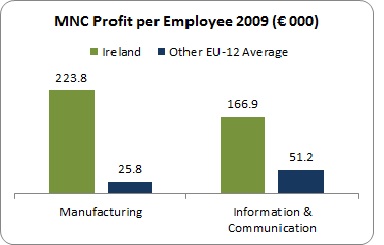
This is just the overview – let’s look at some key MNC
sectors in Ireland.  In the Manufacturing
and Information & Communication sectors, Irish MNC profits are through the
roof.
 
MNC 2

 In the Manufacturing sector, MNC profitability in Ireland is
nearly 10 times that of MNCs in other countries.  In the Information & Communication, the
ratio is more than three-to-one. 

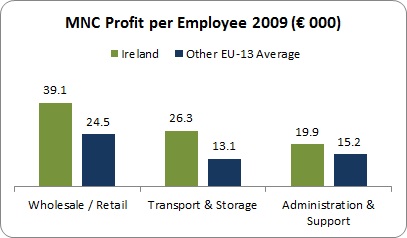
In other sectors, MNCs in Ireland also exceed the EU average
but not to the same degree.
 
MNC 3


In each of these sectors – particularly retail and transport
– MNC profits in Ireland significantly exceed the average of other countries.

Only in two sectors – the Professional & Scientific and
Accommodation – is MNC profit in Ireland lower than the average of other EU
countries.  These two sectors, however,
are relatively small, making up less than 2 percent of the turnover of all MNCs
in Ireland.

Another insight is MNC by home country.  US multi-nationals have a strong presence in
Ireland – making up nearly two-thirds of all MNC turnover in Ireland.  American MNCs take €240,000
in profit per employee here in Ireland; in the other EU countries, they take
only €31,800.  More interesting, despite
the global recession, American MNCs increased their profit per employee in 2009
by over 8 percent in Ireland.  In other EU
countries, American MNCs suffered a loss of nearly 21 percent.

Another, albeit smaller category, is
MNCs owned by ‘offshore financial centres’ (OFCs).  One would assume that these would be
primarily involved in the financial sector.  But the data here refers to the non-financial
business sector.  These OFCs are still
relatively small (making up only 3 percent of all MNC turnover in Ireland).  But they are growing.  In the dark days of 2009, OFCs saw their
turnover nearly double over 2008, with the number of OFCs operating in Ireland also
doubling.  And no wonder:  they take nearly €61,000 in profits per
employed in Ireland while in other countries this figure is nearly half –
€34,300.

Of course, there is an
Alice-in-Wonderland character to all these numbers.  Profits, turnover, value-added – these are
all distorted by transfer pricing.  MNCs
do not actually produce these levels of profit in Ireland – not all of them;
they ‘report’ a considerable level of profit here, taking advantage of transfer-pricing
in order to exploit our ultra-low corporate tax rates and the facility to
engage in global tax avoidance (which is why a US Senate Committee described
Ireland as a tax haven
– see page 30). 

But we should also take note:  all of the above reports profits before
tax.  If we had an after-tax figure, we’d
find the gap between MNCs in Ireland and the other EU countries grow even
wider.  For instance, Germany comes
second when it comes to MNC profit per employee at €42,600.  On that they pay a headline corporate tax
rate of 30 percent.  In Ireland, with
MNCs taking €110,600 per employee, the headline rate is 12.5 percent.  Yes, the effective tax rate (after reliefs
and allowances) will be lower – but it will be lower for both countries.

Profits
are rising in Ireland
.  They
increased by 4 percent in 2010 and 7 percent in 2011.  According to the CSO, this is largely
accruing to multi-nationals.

So here is a question:  if all things are on the budgetary table, why
is there no place for an increase in the corporate tax rate?  This would not undermine pre-tax profits, and
even if it were raised by a mere 2.5 percent, it would still be lower – much
lower – than almost any other European country.

And here is another question:  where in Europe, indeed the world, can MNCs
make as much profit as in Ireland even if the corporate tax rate were
increased?

So, why is the issue of the corporate
tax rate taboo?  That’s an easy question
to answer:  because it
has
been elevated to almost metaphysical status.  In the Dail the Taoiseach stated
piously
:

‘The key elements of
the Jobs Initiative included: reaffirming, as the Minister for Finance repeated
yesterday, that our 12.5% corporate tax rate remains sacrosanct . . . ‘

To declare something sacrosanct is not an invitation to
debate.  It is a threat.  For to challenge the sacrosanct
is to engage in heresy, blasphemy, apostasy. 

So suck it up.  Cut
homecare help, bash low-paid workers (public and private), slash social
protection, close down services, tax average income earners even more.  But don’t anyone dare mention the holy of
holies – the corporate tax rate. 

As
Minister Creighton says – stop whingeing
. 


In each of these sectors – particularly retail and transport
– MNC profits in Ireland significantly exceed the average of other countries.

Only in two sectors – the Professional & Scientific and
Accommodation – is MNC profit in Ireland lower than the average of other EU
countries.  These two sectors, however,
are relatively small, making up less than 2 percent of the turnover of all MNCs
in Ireland.

Another insight is MNC by home country.  US multi-nationals have a strong presence in
Ireland – making up nearly two-thirds of all MNC turnover in Ireland.  American MNCs take €240,000
in profit per employee here in Ireland; in the other EU countries, they take
only €31,800.  More interesting, despite
the global recession, American MNCs increased their profit per employee in 2009
by over 8 percent.  In other EU
countries, American MNCs suffered a loss of nearly 21 percent.

Another, albeit smaller category, is
MNCs owned by ‘offshore financial centres’ (OFCs).  One would assume that these would be
primarily involved in the financial sector.  But the data here refers to the non-financial
business sector.  These OFCs are still
relatively small (making up only 3 percent of all MNC turnover in Ireland).  But they are growing.  In the dark days of 2009, OFCs saw their
turnover nearly double over 2008, with the number of OFCs operating in Ireland also
doubling.  And no wonder:  they take nearly €61,000 in profits per
employed in Ireland while in other countries this figure is nearly half –
€34,300.

Of course, there is an
Alice-in-Wonderland character to all these numbers.  Profits, turnover, value-added – these are
all distorted by transfer pricing.  MNCs
do not actually produce these levels of profit in Ireland – not all of them;
they ‘report’ a considerable level of profit here, taking advantage of transfer-pricing
in order to exploit our ultra-low corporate tax rates and the facility to
engage in global tax avoidance (which is why a US Senate Committee described
Ireland as a tax haven
– see page 30). 

But we should also take note:  all of the above reports profits before
tax.  If we had an after-tax figure, we’d
find the gap between MNCs in Ireland and the other EU countries grow even
wider.  For instance, Germany comes
second when it comes to MNC profit per employee at €42,600.  On that they pay a headline corporate tax
rate of 30 percent.  In Ireland, with
MNCs taking €110,600 per employee, the headline rate is 12.5 percent.  Yes, the effective tax rate (after reliefs
and allowances) will be lower – but it will be lower for both countries.

Profits
are rising in Ireland
.  They
increased by 4 percent in 2010 and 7 percent in 2011.  According to the CSO, this is largely
accruing to multi-nationals.

So here is a question:  if all things are on the budgetary table, why
is there no place for an increase in the corporate tax rate?  This would not undermine pre-tax profits, and
even if it were raised by a mere 2.5 percent, it would still be lower – much
lower – than almost any other European country.

And here is another question:  where in Europe, indeed the world, can MNCs
make as much profit as in Ireland even if the corporate tax rate were
increased?

So, why is the issue of the corporate
tax rate taboo?  That’s an easy question
to answer:  because it is no longer a
policy issue around which we can have a rational discussion.   Rather,
the corporate tax rate has
been elevated to almost metaphysical status. 
The Taoiseach in the last budget stated
piously
:

‘The key elements of
the Jobs Initiative included: reaffirming, as the Minister for Finance repeated
yesterday, that our 12.5% corporate tax rate remains sacrosanct . . . ‘

To declare something sacrosanct is not an invitation to
debate.  It is an injunction not to
debate.  For to challenge the sacrosanct
is to engage in heresy, blasphemy, apostasy. 

So suck it up.  Cut
homecare help, bash low-paid workers (public and private), slash social
protection, close down services, tax average income earners even more.  But don’t anyone dare mention the holy of
holies – the corporate tax rate. 

As
Minister Creighton says – stop whingeing
. 
 

11 responses to “Treasure Ireland”

  1. tells.it.like.it.is Avatar
    tells.it.like.it.is

    I’m always puzzled by the tone of mild distaste that union figures adopt when discussing the MNC sector. Maybe it’s driven by a sense of “otherness”, given that such figures predominantly represent workers in the sheltered and/or low-tech sectors. However the key realization that appears to be lacking is that we’d scarcely have an advanced economy at all if the MNC sector was to take flight in the morning.
    The distaste is usually accompanied by a vague suggestion that the large profits made by MNCs based in Ireland are somehow untoward and unreal, deriving mostly from the double-Irish scam and not reflecting any real-world value in the Irish operations of these companies.
    Consider an example, Amazon Web Services runs several massive data centers in the Dublin region and a large engineering office in Kilmainham. Why do AWS make more profits than say a shoe manufacturer basing themselves in Portugal to take advantage of cheap local labour?
    Because of genuine technical innovation and first-mover advantage deriving from effectively creating the mass market in cloud computing.
    Contrast with the shoe manufacturer in Portugal … there haven’t been many disruptive, paradigm-shifting innovations since European peasantry transitioned out of wooden clogs. Is it really surprising that margins are a wee bit thiner, given the long period of commodification?
    Lastly to address your question on why the current coporation tax rate is considered sacrosanct. There is a large contingent on the left side of the ailse in this country who are generally pro-tax, with one key priviso … that the tax rises only apply to the “other guy”.
    Without the taboo around raising the 12.5% rate, just another little increase would be proposed to avoid every difficult tax/spending decision. Don’t like the USC? Just add a little to the corpo tax rate. Not down with the household charge? Grab some of those juicey MNC profits instead. Leery about cutting public sector allowances for eating lunch at one’s own desk? A few more pennies on the corpo tax rate can’t hurt, right …
    See where I’m going with this?
    Before long, we’ve a 30% corpo tax rate, our economy has stepped back to the 1950s and the most advanced employer in the country is cutting turf in the midlands.

    Like

  2. Ernie Ball Avatar

    That “slippery slope” argument is about as convincing as the Domino Theory was in southeast Asia.
    Instead of the prospect that tell.it.like.it.is is so very concerned about, what we get in Ireland by preserving the sacrosanct corporate tax rate is rather this (real) slippery slope:
    Don’t like taxing profits appropriately? Just impose a public sector “pensions levy.” Got to pay another installment on the Anglo promissory notes? Just cut special needs assistants. Want to keep bankers living in the style to which they’ve become accustomed? Just cut student grants. You see where this is going…
    The point that is missed by those on the other side is that choosing to preserve MNC bottom lines is done at the expense of everyone else.

    Like

  3. tells.it.like.it.is Avatar
    tells.it.like.it.is

    It’s not a case of preserving the MNC’s bottom lines, it’s a case of preserving their presence in this country.
    And in doing so, retaining our position as an advanced Western economy with a functioning tech industry.
    You know, Ernie, I sometimes think that certain commentators really do want to return to the 1950s.
    A low-tech, hand-to-mouth economy where public sector desk jobs the ultimate in statusful employment. An under-educated, docile workforce, subs-fodder for the unions, hoping against hope that the factory making Aran sweaters for the tourists will last another year. Maybe next year Bord na Mona will taking on turf-drying apprentices at 7 shillings a week.
    Everyone will know their place then, wha’?

    Like

  4. Ernie Ball Avatar

    And what, other than excessive fealty and superstition and specious slippery slope arguments, leads you to believe that MNCs would leave Ireland if the corporate tax rate were raised to, say, 15% as Michael Taft suggests? Or is it that we (magically or luckily) just happened upon the exact rate on the Laffwr curve where any increase in rates results in a lower tax take. If you want to make that case you’ll need something more than bogus slippery slope arguments.

    Like

  5. tells.it.like.it.is Avatar
    tells.it.like.it.is

    Ernie, your argument is circular – if a jump from 12.5% to 15% would be OK because there’s nothing magical about 12.5%, then so would a jump from 15% to 17.75% or whatever next step is proposed to avoid less palatable revenue raising measures or cost cutting. Rinse and repeat …
    The key point to internalize is that the MNCs are not here for the weather, or the great craic in the pub on a Friday night after work.
    (And they are certainly not here because of our “world-class” education in STEM fields. In fact, outfits like the Dublin AWS operation mentioned above lean far more heavily on STEM education in other countries – they have to import the engineering talent because we prefer to retain unqualified maths teachers and pay some of them more than a distinguished maths professor would get elsewhere, and then we wonder why so few kids want to do engineering or computer science.)
    The presence of the MNCs here is completely predicated on the system of incentives that attracted them here in the first place. Take away those incentives and they will leave, simple as.
    Which I suspect is the desired result for some people. I’m reminded of teachers complaining in the media about their relative status, around the turn of the century. A common refrain was that some young whippersnapper from the wrong side of town that they had thought only a few short years previously was now ensonsced in some big software job up in Dublin, earning more than the teacher did. The temerity of them!
    Anywhere else the presence of a highly profitable MNC sector providing well-paying jobs to highly skilled graduates would be considered a result!
    Here it was considered an inversion of the natural order of things.

    Like

  6. Ernie Ball Avatar

    My argument is not circular at all. There may be a point at which a further increase in the rate results in decreased revenue. However, it is nonsense to claim to know that 12.5% is the magic number based on . . . nothing.
    Nobody here is arguing that the rate should be 50%. And arguing for a 15% rate is not, ipso facto, arguing for a 50% or a 100% rate, as you seem to think. Indeed, it seems reasonable to assume, despite your alarmist rhetoric, that an increase to 15% would not result in many MNCs upping stakes and would increase revenue.
    I’ll leave aside the rest of your blather about what you presume is the “natural” order of things (dictated by the all-knowing market, of course) where beginning software developers are more valuable than career teachers other than to say that you may have noticed that some of the best-remunerated people on this island at the turn of the century were working for banks like Anglo. Were they more valuable to us than teachers? Your social darwinism requires you to answer in the affirmative.

    Like

  7. tells.it.like.it.is Avatar
    tells.it.like.it.is

    “There may be a point at which a further increase in the rate results in decreased revenue.”
    It’s all about the revenue with you, Ernie.
    Note that I mentioned nothing about revenue yields above, rather I focused on the effect on jobs, particularly in the high tech sector (which would barely exist without the MNCs).
    Even the way you pose the question is completely focused on the how-much-can-we-squeeze-out-of-Johnny-Foreigner before he up’s sticks.
    Note that the dynamic here is much different to shaking down the ordinary individual tax-payer in order to avoid reforming the massively inefficient and under-performing state apparatus.
    My definition the MNCs are highly mobile, they wouldn’t have came here if there weren’t. They often have outposts in many other low-tax countries also plying for their trade. The inertia level is low, except in special cases such as Intel with large plant investments, and even then the lifecycle of such infrastructure is short and forward-looking investment can quickly be hived off to Israel or elsewhere.
    And the cavalier attitude with which you muse on “not many” MNCs leaving shows what how insular a job-for-life makes one.
    “… where beginning software developers are more valuable than career teachers”
    If by career teachers you mean those with decades of experience, I can assure you that starting salaries in the software industry never exceeded the total packages enjoyed by such teachers, never even came close (either pre- or post-benchmarking).
    And I won’t even grace that irrelevant whataboutery on the Anglo bankers salaries with a response, except to note that despite the name, Anglo wasn’t really an MNC.

    Like

  8. Ernie Ball Avatar

    Of course it’s about revenue. But it’s also about basic fairness. Everyone in this society has been asked to sacrifice for the common good . . . except the corporations. Is it fair or wise for corporations to pay tax (on astronomical profits) at a rate roughly 1/2 to 1/3 of what a PAYE worker pays? Your logic is exactly the same one that says the Anglo bondholders must be paid off at all costs: we can’t afford to displease our wealthy betters and fairness be damned. Let’s cut special needs instead.
    So let me put the question another way: what exactly is unfair or unwise about a 15% rate, bearing in mind that a 15% rate is not some sort of gateway drug to a subsequent 50% rate?
    And don’t tell me it’s because “companies will leave” unless you have some evidence to back that up.

    Like

  9. tells.it.like.it.is Avatar
    tells.it.like.it.is

    “Of course it’s about revenue.”
    Actually, it’s not. Not about the primary revenue stream in the case of FDI in the high-tech sector.
    Its more about secondary revenue (PAYE & PRSI on the salaries paid out), and the network effects in seeding an indigenous tech sector.
    Well it would have been about the latter if our education sector wasn’t so pitifully unfit for purpose (and in this context, that has nothing to do with the lack of SNAs – teachers unable to reach the basic standard of a third level mathematics qualification are simply lacking in the skill-set necessary to inspire and foster promising engineering talent).
    “Is it fair or wise for corporations to pay tax (on astronomical profits) a rate roughly 1/2 to 1/3 of what a PAYE worker pays”
    One word, choice.
    PAYE workers generally don’t got one. Stuck in Ireland, familial ties and negative equity will keep most here, regardless of how they are fleeced.
    MNCs do have a choice. To up sticks and leave. And believe you me, they will exercise that choice if treated as a cash cow.
    Simple as.

    Like

  10. Ernie Ball Avatar

    MNCs do have a choice. To up sticks and leave. And believe you me, they will exercise that choice if treated as a cash cow.
    Good god: Michael proposes raising the corporate tax rate by 2.5% percentage points and suddenly he’s treating the poor poor multinationals as a “cash cow.”
    Meanwhile, I note with interest your attitude toward PAYE workers who really are cash cows (because they can’t leave).
    You have yet to provide even a single justification for maintaining the corporate tax rate at 12.5% other than your faith that the “lack of confidence fairy” will take away all the bright shiny MNCs. This is just abject nonsense and not based in anything.
    By the way, you should stop speaking in semi-literate clichés like “simple as.” It makes you sound like a halfwit.

    Like

  11. tells.it.like.it.is Avatar
    tells.it.like.it.is

    Eh, where does this quote come from: “lack of confidence fairy”?
    I’ve argued nowhere that MNCs will leave because of some ill-defined lack of confidence. Such arguments are generally applied to consumer spending decisions. Strange as it may seem, MNCs actually bring a different sensibility to their multi-million dollar investment decisions, than a housewife would bring to purchasing a new washer/dryer.
    With regard to evidence, you seem to want to try it out, see how far it can be pushed before we start seeing disinvestment. Unfortunately you can’t run a simulation and get back a predicted optimal rate of corpo tax. The evidence we have is that (a) the current rate attracted them here, and (b) we’ve seen before that once the economic calculus tilts in the wrong direction in terms of the costs & benefits of a location, MNCs tend to vote with their feet and quickly (Dell, I’m looking at you).
    Of course, it may seen attractive from your secure, over-pensioned perch to play around with the one sector of the economy that is actually functioning successfully. You’re not going to loose your livelihood if it all goes pear-shaped. Or so it seems at least, until you work out exactly how much total revenue (corpo, payroll & consumption taxes) the state would lose if we saw widespread disinvestment. Lets just say the box-making, franking-machine-operating and black-or-blue-shoe-wearing allowances may have to go.
    “I note with interest your attitude toward PAYE workers who really are cash cows”
    Don’t shoot the messenger, we’ve been treated that way by the Irish state apparatus for generations.

    Like

Leave a comment

Navigation

About

Commentary on Irish Political Economy by Michael Taft, researcher for SIPTU