Notes on the Front

Commentary on Irish Political Economy by Michael Taft, researcher for SIPTU

Just When You Thought It Couldn’t Get Any Worse

Just when you though it couldn’t get any worse, along comes
the EU Commission with their projections for the Irish economy.  It will make grim reading for the
Government.  All their projections are
being undermined.  Of course, the EU
could turn out to be wrong and the Government right – so we are just dealing
with projections.  However, with media
leaks that the Government will be revising growth downwards in a couple of
weeks, even they are heading in the direction of the EU projections.  Let’s compare some indicators.

GDP Growth

The Government is hoping for a quick return to robust
growth.  The EU is not so hopeful.  The Government is hoping for an average
annual growth rate of 2 percent up to 2014. 
The EU expects it be 1.2 percent. 
At that level, the economy is stagnating.

Employment

To bring down unemployment, there has to be job
creation.  To absorb new entrants into
the market and reduce the dole queues. 
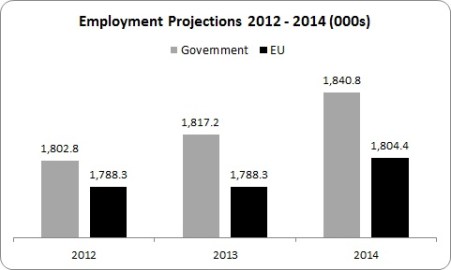
But the EU suggests that job creation will be sluggish over the medium
term.
EU Forecasts 1

The Government is hoping that there will be 31,000 more
people at work by 2014 compared to last year. 
The EU projects that there will be 5,000 fewer people in employment by
2014 compared to last year.  That’s why
unemployment will remain so high and why emigration will continue apace.

Real Wages

People are trying to deal with higher taxation, higher
prices and some of the highest debt levels in Europe.  All this might be bearable if real wages were
rising – that is, wages were rising after inflation.  Even the Government’s projections are
pessimistic.  They project that average real
wages will be static in 2014.  The EU,
however, projects that average real wages will fall by 1.4 percent.  Hard to see households coping with that. 

Investment

Investment is the key. 
Drive investment (and in the right places) and we can start to turn this
mess around.  The Government is hoping
that investment will rise by 3 percent by 2014 – not much, but better than
nothing as the saying goes.  But, again,
the EU throws cold water on that projection – suggesting that investment will
fall by 3 percent up to 2014. 

But, saving the worst for last:

Unemployment

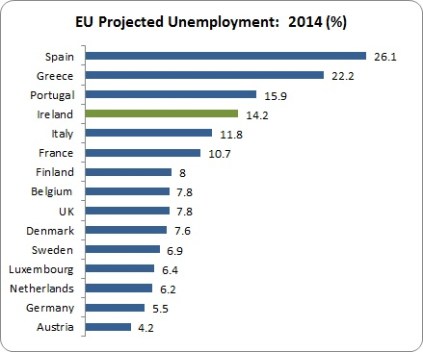
When the Government took office last year, unemployment was
14.2 percent.  To be fair to any new
Government, it takes time to bring down the unemployment rate – especially after
it increased so quickly under the previous Government.  But after the Jobs Initiative, the Action
Plan for Jobs, a ‘jobs-friendly’ budget last year – the EU is projecting that
unemployment will still be 14.2 percent in 2014. 
EU Forecasts 2

Ireland will be a relative outlier, though not as bad
as chronic Greece and Spain.  Still, the
majority of EU-15 countries are estimated to have unemployment rates in single
figures.  We are a long, long ways from
that.

And these are not just numbers on a page.  This will have a real impact on people’s
lives – more joblessness, more emigration, reduced living standards.  And it will have an impact on the budgetary
arithmetic.  With lower growth and higher
unemployment, even more cuts and tax increases will be necessary to keep the
austerity programme on deficit-reduction target – at least, on paper.

Personally, I didn’t expect this level of pessimistic
revision.  One day I’ll learn.

12 responses to “Just When You Thought It Couldn’t Get Any Worse”

  1. eamonn moran Avatar
    eamonn moran

    Hi Michael as you work for a Trade union I have to point something out with regard to unemployment. The Croke park agreement has guaranteed a huge increase in youth unemployment.
    Steady wages have been exchanged for numbers of workers in the public sector. Very few young people are being employed anymore in the PS. This is a deliberate policy that is having catastrophic consequences for youth Emigration and Youth unemployment Which has gone from 5% to 35% since 2007.
    Compare this to what all 3 parties in the UK agreed.
    Real wage decreases in exchange for protecting the current level of jobs.

    Like

  2. Michael Taft Avatar

    Eamonn – just to clarify. The Croke Park Agreement has nothing to do with the reduction of public sector employment. That was a policy that was initiated in 2008 (the moratorium) and precedes the agreement. The CPA is a productivity deal – in exchange for not cutting nominal wages, workers agree work practice changes. Any criticisms about policy of reducing public sector employment (and I agree with the criticisms as you know) is a criticism of Government policy.
    Second, public sector workers have already agreed real wage decreases. Their nominal wages were cut in 2009 and again in 2010. Real wages were were cut last year and this year – and will be cut in 2013 and 2014, as per the terms of the CPA.

    Like

  3. tells.it.like.it.is Avatar
    tells.it.like.it.is

    “The Croke Park Agreement has nothing to do with the reduction of public sector employment.”
    What an extraordinary statement!
    If true, why are the payroll savings from reduced staffing levels always included in the purported savings from the CPA?
    Without those savings, the CPA would have yielded almost nothing in financial terms.
    In fact, most of the other savings are purely invented and even then made with reference to the payroll savings.
    For example, the notional non-pay savings calculated as 40% of the payroll reduction (that all departments other Agriculture have been bandying around).

    Like

  4. Michael Taft Avatar

    tell.it.like.it.is – as to why payroll savings are included in CPA savings, I’m afraid you’ll have to ask those who make such statements. Employment reductions started in 2008, well before the CPA. The CPA is a productivity deal – change in work practices to increase output in exchange for no further pay cuts. Unfortunately, the debate is highly confused on this topic and no amount of clarification is likely to change that.
    As to my own analysis on the issue of payroll squeezing you might wish to read here: http://notesonthefront.typepad.com/politicaleconomy/2011/11/they-cheer-little-realising-they-are-cheering-their-own-failure.html

    Like

  5. tells.it.like.it.is Avatar
    tells.it.like.it.is

    Micheal, are we talking about the same agreement?
    “Public Service Commitments
    Reduction in Public Service numbers
    1.5 To facilitate the necessary reduction in numbers of public servants, the moratorium on recruitment to and promotion in the Public Service and other employment numbers control mechanisms will continue to apply until numbers in each sector have fallen to the appropriate
    level specified in the Employment Control Framework for that sector. In addition, where the
    circumstances require it, the Government may offer voluntary mechanisms to exit the Public Service, whether generally or in specific sectors, bodies, locations or services.”
    http://per.gov.ie/wp-content/uploads/Public_Service_Agreement_2010_-_20141.pdf
    I don’t see how it could be any clearer, the PSA explicitly and directly sets out that recruitment will be constrained in order to reduce numbers.
    And on this …
    “I’m afraid you’ll have to ask those who make such statements.”
    Note that its just randomers in the blogosphere or loose cannons on the union side making up these claims, its the actual Implementation Body set up by the agreement that has based its entire reporting strategy on claiming payroll savings as deriving from the CPA.

    Like

  6. Michael Taft Avatar

    tell.it.like.it.is – thanks for that quote. I think this will help clear up the confusion. As stated in 1.5, the moratorium will ‘continue’ and the numbers will be set by the Employment Control Framework which is a function of Government policy, not industrial bargaining. The Government can set the number at x or y or z. It can actually increase the numbers, not cut. This was established in the agreement to prevent industrial action on the issue of numbers. But as stated, it is a continuation of a policy that was started by the previous Government, continued by the current Government and is not subject to negotiation but rather Government decision. It is up to the Government at any time to stop reducing the overall numbers in the Employment Control Framework. Even if they did that (they won’t but they should) the CPA is still in force.
    Whether employment increases, decreases or stays the same the undertaking by public sector workers under the CPA remain the same.
    I think the section you quoted should clarify the issue.

    Like

  7. Eamonn Moran Avatar
    Eamonn Moran

    Michael my point is very simple. The net result of Croke Park is to exchange no further wage cuts for increased productivity resulting in no new employees being required. The Unions in the UK fought for similar actions in the UK. However all parties including the Labour party over ruled them as it would be bad for jobs. The politicians did the right thing for the economy dispite the short sighted policies of the unions. Since you are an economist that works for a union I am hoping you might at least privately try to explain that the result of the policy actions in Ireland are increased youth unemployment, increased emigration and and a major lag on growth in the medium and long term due to a large portion of people in their 20’s being excluded from the economy. I genuinely don’t think the union heads understand the damage they are doing. All I am pleading with you to do is perhaps educate them in private. The policies in northern european countries of keeping youth unemployment under control is in direct contrast to the latin (more short sighted) European economies. Ireland has copied the Latin models of excluding a generation in order to maintain wage increases that were based on economic growth figures we now know to be the result of a massive bubble.

    Like

  8. Michael Taft Avatar

    Eamonn – again, there is considerable confusion here. The net result of CPA is not that public sector employment is declining. That is a Government policy. For instance, productivity savings may result in the reduction of unproductive or under-productive jobs. The Government could take those ‘savings’ and reinvest them into expanding early childhood education or rolling out affordable childcare – each of which would be labour dense. That they don’t is not a function of the CPA but of the austerity policies they are pursuing. The criticism that PS employment is falling is one that should be directed at the Government (as stated in the Programme for Government).
    As to your last sentence – I would suggest that you have a read here http://www.unitetheunion.org/pdf/The%20Real%20Cost%20of%20Irish%20Labour%20-%20A%20response%20to%20the%20Central%20Bank.pdf and here: http://www.unitetheunion.org/pdf/The%20Cost%20of%20Irish%20Labour%20-%20Appendix%20Tables.pdf. None of this suggests inflated wages in comparison to other European countries. As to PS wages, workers took a nominal wage cut in 2009 and, again, in 2010, followed by real wage cuts in 2011 and 2012. During that period unemployment and youth unemployment rose substantially. I would make this same analysis in private and public.

    Like

  9. tells.it.like.it.is Avatar
    tells.it.like.it.is

    With respect, Michael, I think you’ve dug yourself into a hole on this one.
    The fact that headcount reduction was prior government policy is neither here nor there. Agreements are almost always the crystallization of the prior policy of one or both parties to the agreement … these measures set out in an agreement don’t magically spring into being during the long nights of stage-managed negotiation.
    Also I don’t how you can realistically claim that:
    “Whether employment increases, decreases or stays the same the undertaking by public sector workers under the CPA remain the same.”
    The main bargaining chip conceded by the union side was agreement to facilitate staff redeployment.
    (The much vaunted commitment to “industrial peace” is almost without value, given that even in the era of public sector pay cuts there was virtually no “industrial war” going on, save that single day’s shopping spree in Newry and a minor rukus in the passport office).
    Now the whole purpose of these redeployment measures being negotiated was to facilitate the reduction in headcount. If headcount were static or increasing, we wouldn’t need to redeploy staff – so in fact the main undertaking of the workers’ side is completely predicated on headcount reduction taking place.
    Now we often hear union figures presenting the impact on younger qualified teachers/nurses etc. as being an unhappy side-effect of the CPA, totally outside their control. But in fairness Michael, I’ve never heard anyone go so far as to claim that the CPA has nothing to do with headcount reduction – to do so is deny the basic reality.
    There would have been many ways to skin the cat in terms of reducing public payroll. Each approach would have had a different set of winners and losers. The route chosen has the quality of transferring most of the future cost onto the next generation of public sector workers, while leaving those near the top of the payscale safe from future paycuts or redundancy and those in their late fifties/early sixties free to retire on very generous packages. The fact that union structures are dominated by those age-groups that benefited most from the arrangements is no accident. And to claim that this wasn’t on the agenda of the union side during the negotiations really is to beggar belief.

    Like

  10. eamonn moran Avatar
    eamonn moran

    Hi Michael. I took a look at the first link (the second one didn’t work for me)
    No where in the Unite report does it show the dramatic increase in labour costs (especially at the upper end) between 1998-2008. Increases that bore no relation to GDP increases or CPI but were a result of Benchmarking. Benchmarking has been completely discredited as a FF rouse to buy votes in a bubble. I am not interested in arguing over symantics. The previous posters last paragraph is correct. Think about the longterm interests of your own union. Union membership is going to go off a cliff in about 20 years time due to the short sighted policies that the unions are supporting.
    I am sure you are aware of the level of new employees into the PS over the last few years. The unions are making a rod for their own backs.

    Like

  11. Michael Taft Avatar

    tell.it.like.it.is – I’ll leave you with the last word save for this: it is just as important to look behind accounting exercises pretending to be economics (e.g. cuts = savings)as it is to look behind contractual arrangements masquerading as fiscal correction. If we don’t, the debate will remain stuck in its current myopia with preconceptions dominating empirical observation. We’ll just keep repeating – cut jobs, cut wages, cut jobs, cut wages . . .
    Eamonn – if you’re suggesting that social partnership hollowed out trade union activism, I agree. If you’re suggesting that the collective trade union movement has not been robust or convincing in putting forward expansionary fiscal and economic policies, I agree. However, it is important to go beyond clichés and ‘accepted wisdom’ when advancing an argument. For instance, between 1998-2008, PS weekly wages increased by 71%; manufacturing wages (operating in highly competitive traded sectors) rose by 73%. Were we paying ourselves too much? No. Capital was paying itself too much and Fianna Fail used bubble revenue to persuade people that private markets could satisfy public-goods needs.

    Like

  12. eamonn moran Avatar
    eamonn moran

    Hi Michael I just came across some very interesting Stats thanks to Seamus coffee. The ISA’s from last week.
    They give a very detailed breakdown of Public sector numbers on page 14 and pay and pensions pages9-13
    http://per.gov.ie/wp-content/uploads/Analysis-of-Exchequer-Pay-and-Pensions-Bill-2006-2011.pdf
    It seems clear the main issue with regard to sustainability is not PS pay but their pensions. Education deserves a special mention as the provisions for education pensions are nearly double that of health even though there less people employed in education than health

    Like

Leave a comment

Navigation

About

Commentary on Irish Political Economy by Michael Taft, researcher for SIPTU