
The
Exchequer figures are out. And they
are not good. Coming into this year, the
Government had a strong wind at its back, with €1 billion being carried forward
from Budget 2011. That wind has blown
itself out and the Government is looking at a deteriorating situation.
The best way to compare tax returns is not necessarily with
targets. Targets can be moulded in ways
to show all manner of results; for instance, set low targets that you know will
be achieved .and voila, you have succeeded.
A better way is to compare with last year. In that way, we can see how the economy is
performing.
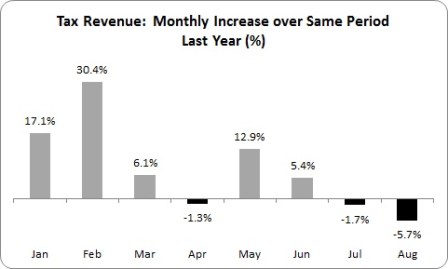
As seen, in the first two months of the year, tax revenue was
significantly higher than in the same period last year. This reflected the carry-forward of mentioned
above. However, since then, returns have
been disappointing. Falling in March and
April, it rose again in May. However,
since then it has been downhill. Tax
revenue in July and August was below the tax returns of last year. Dan O’Brien points out:
‘In the June-August
period, tax revenue was below the same period last year. This is the first time
since 2010 that a year-on-year decline in revenue has been registered for a
three-month period.’
There is another important note: not only did the Government benefit from a €1
billion carry-forward, it also increase taxes.
Approximately €1 billion in additional tax revenue was pencilled in for
2012. However, not all that will accrue
to the Exchequer and, so, will not appear in the Exchequer numbers (increase in
PRSI payments go the Social Insurance Fund while the Household Charge is a
Departmental receipt). Still, with a €1
billion carry-forward from last year and hundreds of millions more in new tax
measures, tax receipts are starting to decline over last year.
When we turn to income tax/USC receipts we see the same
trend.
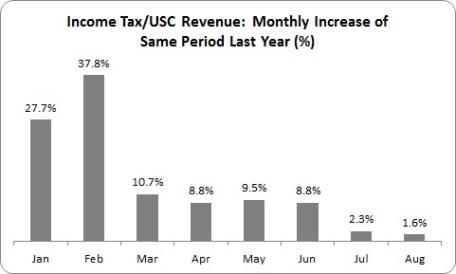
The big boost in the first two months reflects the €1
billion carry-forward. Afterwards income
tax/USC remained steady. However, in the
last two months we have seen a considerable fall. But as always with Exchequer returns, there
are small caveats. Some of this revenue
should actually be earmarked for the Social Insurance Fund (being PRSI
receipts). The above, therefore, slightly
flatters revenue figures. Whereas to the
end of August, the Exchequer figures show income tax/USC revenue to by 12.9
percent higher than last year, in the Information Note the Department of
Finance admits that the figure is below 10 percent.
With regards to VAT, receipts are €208 million, or 3.1
percent higher than last year up to the end of August. The Government is hoping VAT will bring in €254
million more than last year by the end of December, or a 2.6 percent
increase. However, we should remember
that the Government estimated that the VAT increase would yield €560
million. The discrepancy can be put down
to lower consumer spending. The VAT
increase would have contributed to this lower spending. The point here is that an adjustment of €560
million will actually only yield an increase of less than half that
amount.
It may well be that things will improve later this year –
especially with the self-employed receipts.
However, at this stage, Exchequer returns are deteriorating. Seamus
Coffey shows, that when you strip away bank capitalisations and once-off
payments, the current budget deficit is getting worse (this measures all
current expenditure).
‘All told, in the first eight months of 2012 the overall
current budget deficit is €429 million bigger than it was last year.’
So tax revenue is falling off, the current account deficit
is growing. And
the €130 million in health cuts is just the start; there is more, much
more, in store for us.
But hey, don’t worry, we’re hitting our targets. Go back to sleep, Ireland. All is well.
 Notes on the Front
Leave a comment