
After one year in office we can now see how the Government has fared with unemployment. The data is not encouraging at all. Since the 1st quarter of 2011, when we swapped governments, Fine Gael and Labour have launched a Jobs Initiative, a ‘job-protection’ budget, and an Action Plan on Jobs. So far, what has been the result? In the last year:
- Unemployment has increased by nearly 14,000 – increasing from 14.1 percent to 14.8 percent
- Long-term unemployment has increased by nearly 25,000 – rising from 7.8 percent to 8.9 percent.
- Long-term unemployment now makes up 60.6 percent of all unemployment, up from 55.1 percent last year.
- Youth unemployment is 30 percent.
A further concern is the continuing fall in the number of people at work. In the last year the number at work fell by nearly 18,000.
Of course, unemployment is not equally distributed. There are wide variations in particular categories. Take the regional breakdown:
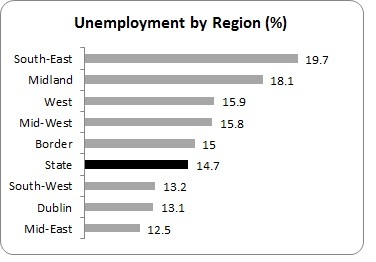
The Mid-East (Meath, Kildare and Wicklow) suffer the least level of unemployment. In the South-East (Carlow, Kilkenny, South Tipperary, Wexford, and Waterford), one in five are unemployed, making it the worst area.
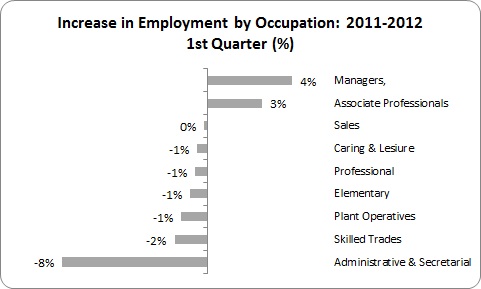
When it comes to occupations, over the last year the administrative and secretarial grades were the worst hit (but at least we’re getting more managers).
There are two statistics that don’t get a lot of attention even though they are published by the CSO. The first is people’s description of their principal economic status. In this formulation 357,000 people describe themselves as unemployed (as opposed to the official tally of 313,000). This is a subjective description. The reason for the difference is that people may be working on a part-time contract, or casually, or in part-time education or even dropped out of the workforce – but, regardless, they describe themselves as ‘principally’ unemployed.
- Under this formulation, 17 percent of the labour force describes themselves as unemployed.
The second statistic is described as ‘Indicators of Potential Labour Supply’. This measures both unemployment and under-employment. Under-employment is defined as someone who is working part-time and wanting to work more (and available to work more).
- Under this formulation, 25 percent of the labour force is looking for work – either a job or more hours.
What do we have to look forward to? More of the same. The Government is estimating that employment will continue to fall this year – by approximately 7,000 with no fall in unemployment.
On any set of measurements the record of this Government is a failure. We have had press releases, policy launches, snappy sound-bites – but unemployment continues to rise.
The tide is rising, the boat is leaking. But where is the captain?

 Notes on the Front
Leave a comment