Notes on the Front

Commentary on Irish Political Economy by Michael Taft, researcher for SIPTU

Fiscal Treaty Files: Hey Everybody, Let’s Stagnate Together

Understandably, in this referendum we are focused on the impact of the Fiscal Treaty on Ireland.  But this is a Treaty for the Eurozone and the entire EU (with the exceptions of the UK and the Czech Republic, which are pursuing their own home-grown austerity policies).  The Government has made much about how the Fiscal Treaty will introduce ‘stability’ and ‘confidence’ in the Irish and European economies.  So what might we expect from this unique experiment in simultaneous austerity and how might it impact on an open economy like Ireland. Will the Fiscal Treaty actually result in ‘stability’ and ‘confidence’? 

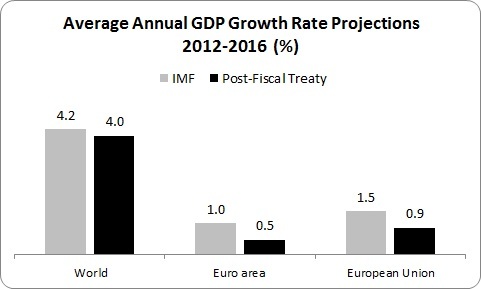
Not according to the Institute for Macro-economic and Economic Research (IMK) based in Germany.  They teamed up with other research institutes in Austria and France to assess the impact of the Fiscal Compact on Eurozone and EU growth.  And the numbers are not good.
IMK 1

The IMF is already projecting that Euro area and EU growth rates will be well below world growth rates.  In a post-fiscal treaty scenario, the IMK projects that European growth rates will be cut further – with Euro area growth rates falling to an insipid ½ percent average annual growth rate.

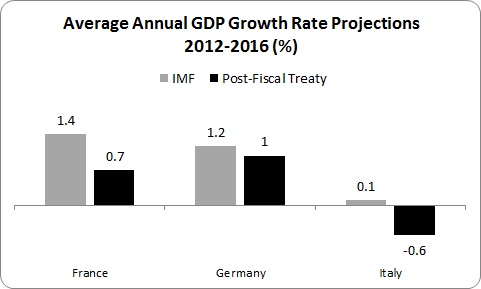
The IMK also looks at specific countries.
IMK 2

It might surprise some that Germany – the ‘engine of the Eurozone economy’ – is already projected to be a low-growth economy under the IMF projections.  Even by 2016, the IMF expects the German economy to grow by a mere 1.3 percent.  However, given that Germany doesn’t have a significant structural deficit issue, the impact of the fiscal treaty will lower growth only marginally.

However, when it comes to France – which does have a significant structural deficit problem – we see that a low-growth economy will find its growth rate cut in half by the Fiscal Treaty.  As for Italy which, like Germany, doesn’t have a significant structural deficit issue, average growth rates fall into negative territory – from an IMF projection which shows them already flat-lining.

The IMK projections for Ireland don’t really work well because they assume all countries the Fiscal Compact would be implemented will meet the structural deficit target by 2016, whereas Ireland may get more leeway coming out of a programme.  However, if we assume that Ireland must meet the structural deficit target what might we expect?

IMK 3

I have assumed that a further €5.4 billion fiscal adjustment would be necessary to close the structural deficit gap by 2017 (€5.4 billion being the gap in 2015).  This adjustment is to start in 2015.  What we find is that GDP growth stagnates at 2014 levels – with implications for unemployment (which the IMF already estimates at over 10 percent in 2017 with a growth rate in excess of 3 percent), incomes and living standards.

And if the Irish growth rates still look better than other countries in the post-fiscal treaty scenario, we always have to remember that GDP is flattered by a multi-national sector which books profits here and then immediately takes them out of the country in what is essentially an accounting exercise.

So all of this is supposed to instil ‘confidence’ and ‘stability’?  Cutting growth rates even further in Europe which is already looking forward to a low-growth medium-term scenario – far below world growth rates?  How does this promote the confidence necessary to increase investment – when domestic demand is being cut in a number of countries simultaneously?  How does this stabilise public finances when economies are going to find it even more difficult to generate the revenues necessary to repay debt?  And what happens to all this math if Spain falls into bail-out?  

For the Government this is a special problem.  Their recovery strategy is based on an expanding export base.  However, if European countries are simultaneously driving down their demand, our markets for exports will be contracting.  How does reduced demand in Europe impact on our real export growth.

This is not a drive to promote ‘confidence’ and ‘stability’ – this is a dangerous experiment that will produce even greater uncertainty.

This is a recipe for extending and deepening stagnation.

But, hey, at least we’ll be doing it together.  As they say, misery loves company.

6 responses to “Fiscal Treaty Files: Hey Everybody, Let’s Stagnate Together”

  1. Seamus Coffey Avatar

    Hi Michael,
    Why do you assume we have to meet the structural deficit target by 2017?
    We are due to leave the Excessive Deficit Procedure in 2015 (and that is still far from certain). If that is achieved we will be subject to the balanced-budget rule from 2016.
    Our medium term budgetary objective is a structural deficit of 0.5% of GDP and that is unlikely to change. The regulation governing the balanced budget rule (1055/2005) says that countries must aim for an improvement in the structural balance of 0.5 percent of GDP as a benchmark.
    We don’t know what the structural deficit will be in 2015 (of course we never will!) but if it is 3.5% of GDP as the DoF project then we would have six years to reach the MTBO.
    As we are a high debt country we would be probably be asked to do in four years. That would still give from 2016 to 2019 to to reach the 0.5% reference value. That allows plenty of scope for economic growth and structural improvement (labour and capital mobilisation) to reduce the structural deficit.
    Suggesting a figure based on a zero growth, zero structural change scenario over a two-year period does not seem very realistic even if we have little idea what will actually be happening in 2016-2019.

    Like

  2. Michael Taft Avatar

    Seamus – thanks for that and I take your point re: timing of fiscal consolidation. Hopefully it can be extended out to 2019. I used the IMF’s 2017 projections as an exercise – merely because I couldn’t find any other growth rate that goes out beyond 2017; and to underscore the IMK’s estimates of the deflationary impact on Eurozone growth. It was the fortunes of the Eurozone that is the focus of the post.
    I’m not sure what you mean by ‘zero-growth’ scenario. I assumed the IMF projection of an excess of 3 percent. As to the ‘zero structural change scenario’ I merely took the IMF projections as the starting point.
    If we stretch out the impact to 2019 starting in 2016, we could find real GDP growth still falling below 3 percent or just hitting it.
    I agree that this period allows plenty of scope for economic growth and structural improvement. Some have us have been arguing for that approach since the start of the crisis. However, it is unlikely that this will occur under this government. They are, after all, intending to take another big swipe at public investment next year and are intending to cut public services/social protection by an even higher amount than this year. Not much hope for labour and capital mobilisation there.
    Do you have any particular proposals for growth and structural change?

    Like

  3. Seamus Coffey Avatar

    Hi Michael,
    I can’t see how you are allowing for growth. You say the gap will be €5.4 billion in 2015 and then say “a further €5.4 billion fiscal adjustment would be necessary to close the structural deficit gap by 2017”. If there was to be an improvement in the economy surely that would so some of the lifting and the entire €5.4 billion gap from 2015 would not have be closed by fiscal adjustment?
    We are required to get a 0.5 percent of GDP annual improvement in the structural deficit. Even an economy running modest growth would come close to that with ‘neutral’ budgets.
    I think there is a little too much rigour being invoked with the fiscal rules. Reading the Code of Conduct of the Stability and Growth Pact shows that there is huge amount of wiggle room. There are certain restrictions being put in place but most of these are to curb unfunded, discretionary changes that lead to deficit increases.
    Cyclical increases in the deficit will be allowed. If we got the deficit below 3% of GDP by 2015 and did nothing to alter budgetary policy from 2016 to 2019 I guess we would be close to our MTBO of 0.5% at the end of the period.
    Compared to the Excessive Deficit Procedure we are going through, hitting the targets for the balanced-budget rule after that will be benign in comparison.
    If I was to make on proposal it would be on the investment side. We are an economy that is devoid of investment. It is understandable from a household and business perspective but the government’s perspective should be much more long-term and should be “running against the tide”.
    We have hammered capital expenditure and it is not because there is a lack of worthwhile projects to understand. Improving the capital base of the economy will improve our productive capacity and this potential will feed through to the EC’s structural deficit estimates. This would reduce the structural deficit as the potential for the economy would be much greater and more of the overall deficit would be attributed to the cycle.
    For every €100 the government spends, €94 goes on current expenditure and only €6 goes on capital expenditure. That is not a healthy division. There is also scope to raise additional revenue to finance capital expenditure.
    Cutting capital expenditure is useful in hitting short-run deficit targets but it does not help the long-run potential of the economy.

    Like

  4. Michael Taft Avatar

    Seamus – I would just point out that the IMF projects GDP growth to be 3.2 and 3.3 percent in 2016 and 2017 respectively (nominal growth to be 4.9 and 5.0 percent). Yet they also project no reduction in the structural deficit. That is the basis upon which I based the projections. I have yet to see any other projections where the output gap is zero and fiscal adjustment has stopped. While I don’t accept the simple explanation that the structural deficit is the residual after the cyclical is taken out, thus requiring fiscal adjustment – the issue is straight-forward: either fiscal adjustments are necessary (which degrades GDP and Potential GDP growth) or we change course and invest in our productive capacity.
    In that respect I fully agree with your suggestion re: capital investment.
    Unfortunately, the Government doesn’t. It is degrading investment (both economic and social) while pursuing a low-tax economy. Given its austerity mind-set, it is doubtful it will take an expansionary approach to repair public finances.
    That is why the IMF projections are so helpful – they assume the current policy approach.

    Like

  5. Seamus Coffey Avatar

    Hi Michael,
    The IMF’s methodology to calculating the structural deficit is different to that used by the EC. The figures from the DoF in the SPU show the IMF approach giving a deficit of 2.5% of GDP in 2015 and the EC approach giving a figure of 3.5% of GDP.
    I am not au fait with the technical differences between their approaches but seen as they provide different estimates it is clear the underlying assumptions are different.
    It would be useful if the Commission’s forecasts extended beyond 2015 so we could see what might be expected to happen to the structural deficit in a “no policy change” scenario.
    While there are merits in using the structural balance as a fiscal target these are the types of knots we can end up in.
    To return to the original point. I don’t think the fiscal rules will force further fiscal adjustment on us post-2015. We will to move towards a balanced budget regardless. However, because we will be out of the EDP the numerical targets will be far less onerous.
    The Excessive Deficit Procedure makes no allowance for the economic cycle. Countries are given deficit targets and they are told to meet them. The Stability and Growth Pact is much more flexible. When talking about reaching the MTBO it says:
    “Member States that have not yet reached their MTO should take steps to achieve it over the cycle. Their adjustment effort should be higher in good times; it could be more limited in bad times.”
    We are in a straitjacket at the moment. Unfortunately the rest of Europe is unnecessarily tied up in a similar fashion. The rigid application of EDP across the entire EU is having detrimental effects. It is all well and good if one or two countries are forced to get their fiscal house in order but it is not sound macroeconomic management to be doing to same to everyone when fiscal profligacy is not what got us into this mess in the first place.

    Like

  6. Michael Taft Avatar

    Thanks for that, Seamus. This has been a helpful exchange. Personally, I’m more inclined towards the IMF numbers as the EU Commission’s method has the economy ‘over-heating’ starting in 2014 – which led the DoF to rightly call this ‘unrealistic’. The IMF projects that the economy will be in negative output until 2017. That seems more reasonable.
    It would be helpful if the EU Commission projected outward with a non-change policy. It would be even more helpful if the Government did this (the DoF’s model surely doesn’t stop at December 31st 2015). But instead the Government avoids the question of future fiscal adjustments with vapid references to growing the productive economy, etc. etc. If they strongly believe that growing the economy will the heavy lifting, why don’t they start now?
    Yes, we are tying ourselves up in knots re: the structural deficit. One of the strings of that knot leads from an international agreement to a constitutional mandate. It is a string we should cut before it chokes us. Unobservable measurements should be guides, not rules.
    I’m not so optimistic as you about future applications of the rules. As you say, the rigid applications today are are having a detrimental effect. If there was some common-sense applied to rule-enforcement, then Greece, Portugal and Spain wouldn’t be in as much trouble (or us, on the verge of a second bail-out).
    Of course, the extent to which common-sense wins out with exemptions, postponements, model-fiddling and ‘turning a blind eye’, the more the Fiscal Treaty will be seen as not working by the markets. This hardly bodes well for ‘stability’ and ‘confidence’.

    Like

Leave a comment

Navigation

About

Commentary on Irish Political Economy by Michael Taft, researcher for SIPTU