
So we have more austerity and less growth, more debt and less jobs, more spending cuts and less investment – welcome to the Government’s Medium-Term Fiscal Statement.
You have to hand it to the authors of the 4-Year plan – they can really turn a phrase in the face of reality. Try this one on:
‘The economy has returned to growth. The Government's strategy is to return the public finances to a sound position and thereby create the essential conditions for strong and sustainable employment growth. Considerable progress has already been made towards stabilizing the public finances. This progress has required a wide range of difficult decisions from citizens to cut spending and raise revenue . . . The Government is making sure to allow the economic recovery that has commenced a chance to strengthen.’
One could write scores of posts on this one simple statement. I’ll do a few but for now what really caught my eye was ‘strong and sustainable employment’ growth. Let’s see what the 4-Year plan means by ‘strong’.

Last year, in Budget 2011 (which was based on Fianna Fail’s National Recovery Plan and endorsed by the EU-IMF) the Government projected unemployment to be 9.8 percent in 2014, the last year in their projections. When the Government came into office they revised growth downwards and, as a consequence, unemployment was revised upwards. One can’t blame them for that – after all, the Fianna Fail/EU/IMF projections were overly (overly) optimistic.
What has the FG/Lab government projected since they came into office? In April, they projected unemployment to be 10 percent in 2015. Then they launched their Jobs Initiative, targeting low-wage sectors with cuts in employers’ PRSI and the reduced VAT rate.
Six months later and the Government are now projecting unemployment to be 11.6 percent. We have two revisions in which the Government has accepted that unemployment will be higher than projected last year. Two questions:
- Does this mean that the Jobs Initiative has failed? Of course, the Government could respond that without the Jobs Initiative unemployment could be higher. Maybe. But the Government has put forward no analysis, no data, no targets and no on-going evaluation regarding their Jobs Initiative measures. Easily asserted, easily denied.
- Is ever higher projected unemployment the result of returning public finances to a ‘sound position’? It was supposed to result ‘strong and sustainable employment’ growth.
Or maybe these are just words to string together to make it sound like everything is going well when very little is going well. Let’s test this ‘strong employment growth’.
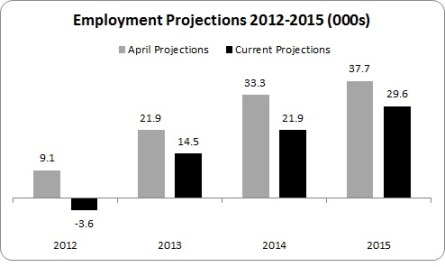
In April, the Government projected net employment to grow by 102,000 over the period 2012-2015. Now they are projecting 62,000. That’s a revision downwards of nearly 40,000. Clearly, this level of growth will not be sufficient to accommodate new labour market entrants, never mind making any kind of substantial dent in the dole queues.
How does this ‘strong employment growth’ compare to unemployment projections throughout the EU? The following are the September projections from the IMF:

With the Government’s projection, Ireland will rank third in the unemployment misery tables – behind only unfortunate Greece and chronically high-unemployment Spain.
The dictionary describes ‘strong’ as ‘mentally powerful or vigorous; especially able, competent; of great moral power, firmness, or courage’.
With unemployment projections rising higher while job creation projections are falling – I leave it to you to determine whether the Government’s action matches its rhetoric.

 Notes on the Front
Leave a comment