
 Over the next 20 years Anglo-Irish (including Irish Nationwide) will cost the Irish taxpayers €90 billion.
Just reflect on that for a moment.
Now repeat: over the next 20 years Anglo-Irish will cost us €90 billion.
It’s difficult to get one’s head around that amount but it is based on figures released last week by Michael Noonan in response to a parliamentary question from Pearse Doherty, TD. Recently, Michael Burke, Tom McDonnell and I co-wrote a post on Progressive-Economy on the subject arguing that the Government should immediately enter into renegotiation with the Irish Central Bank and the ECB with a view to writing down that debt.
At that time, we estimated the cost at €65 billion – based on the Department of Finance’s note dated November 2011. However, the Minister has released a revised schedule of payments. And the cost has risen – substantially. Here I reproduce Tom McDonnell’s calculation from Progressive-Economy. The breakdown is as follows (difference in total due to rounding):
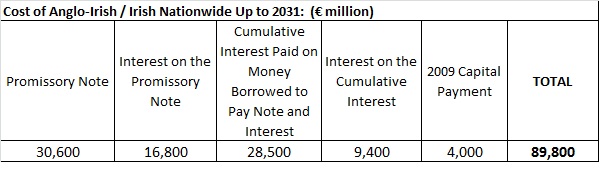
There are a couple of notes here: first, the interest rate used after we exit the EU-IMF funding facility is 4.7 percent – the same rate that the Department of Finance used in their previous cost estimate. Second, the 4th column – Interest on the Cumulative Interest – pertains if the budget is in deficit. Given that even if we were to hit the Maastricht borrowing guideline of -3 percent as a percentage of GDP by 2015 (or 2016 or 2017), it would be a long time before we reached surplus.
So €90 billion is a decent enough estimate. Even if it turns out to be €85 billion, so what? Would it matter to you if a 2.5 ton boulder fell on you rather than a 3 ton boulder?
I won’t bother going through all the proportions and comparisons (this makes up over 70 of GNP this year, etc.). But there is a cost we should consider: opportunity cost.
Opportunity cost is the cost of the next best alternative that is not chosen. For instance, we decide to pay off Anglo-Irish debts rather than, say, installing a Next Generation Broadband; or a state-of-the-art water and waste system; or a pre-primary school system; or a heavily subsidised childcare network; or one-on-one tutorials for those with learning disabilities; or free comprehensive health care; or . . . or . . . or . . . etc. etc. etc. (when you are dealing with €90 billion you are dealing with a lot of ‘or’ and a lot of ‘etc.’.
All these next best alternatives would boost growth, employment and living standards. We can be sure that the value of the €90 billion put into economic and social investment would result in positive multiples measured in terms of GDP. Paying off the Anglo-Irish debt will result in depressed growth as money is siphoned off a weakened economy and mostly flowing out of the country.
As Michael, Tom and myself proposed – it is time the Government announce that it intends to open negotiations with the Irish Central Bank and the ECB with a view to writing down this debt. And until a satisfactory conclusion of that negotiation is reached, the Government should, in my opinion, suspend all payments owed under Anglo-Irish/Irish Nationwide.
And it should do this before November 2nd. For on that date we the people will be forced to pay over €700 million to unsecured and unknown bondholders.
Such a move by the Government would be overwhelmingly supported in all corners (for this is not a left/right issue or a trade union/employer issue – this is an issue of basic economic rationality).
And it would certainly focus minds in any negotiation and help ensure that we come out with the best deal possible – namely, the wiping out of this odious, illegitimate and irrational debt.
 Notes on the Front
Leave a comment