
TASC did something quite unusual, even revolutionary: they looked up the facts. With all the unsubstantiated claims about labour costs, ‘Myths of the Irish Crisis: Wages and Competitiveness’ is truly fresh air in a stale debate. Here I reproduce the data from Eurostat which TASC uses to show that Irish labour costs in low-paid sectors are below European norms. Indeed, labour costs could be up to -9 percent below EU averages – despite the desultory mantras from employers. Let’s first look at the Wholesale/Retail sector.
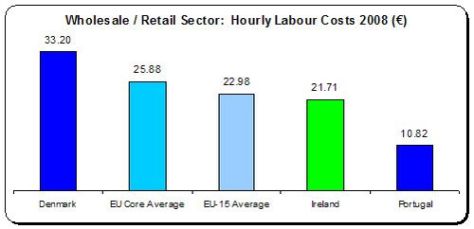
Ireland ranks 10th – well behind European averages. Our labour costs are -5.5 percent below the average of other EU-15 countries – and well behind league-leader Denmark which has an unemployment rate of 6 percent. But when the poorer Mediterranean countries are excluded (such as lowly Portugal), Ireland falls to -16.1 percent behind the average of the EU core countries.
However, when Eurostat factors in living costs (though PPPs), we find Ireland falling to nearly -11 percent behind the EU-15 average and nearly -18 percent behind the EU core countries.
In the Hospitality sector – hotels and restaurants – we find a similar pattern.
Irish labour costs fall -6 percent behind the EU-15 average and -15.4 percent behind the average of EU core countries. And when living costs are factored in, Irish labour costs fall -11 percent behind the EU-15 average and -16 percent behind the EU core countries.
What’s notable is that these figures come from 2008 – the last year of rising income. If we were ‘uncompetitive’, it should have been in this year. We can get a sense of what has been happening to labour costs by turning to Eurostat’s labour cost index which, for most countries, bring us up to 2010. What do we find?
- Wholesale / Retail sector: Irish labour costs increased by 1.3 percent; the EU-15 average increased by 4.9 percent
- Hospitality sector: Irish labour costs fell by -0.2 percent; the EU average increased by 3.4 percent
So, in 2008 Irish labour costs in the low-paid sector trailed European averages. Since then, the gap has widened. While this is provisional (as we don’t have labour cost increases for France, Sweden and Denmark) we could find that labour costs in both sectors are -9 percent below EU-15 averages in 2010.
Those are the unvarnished facts. Next time you hear a spokesperson from IBEC, the RAI, ISME and the SFA going on about ‘the highest labour costs’ in the EU – you’ll know.
They are simply refusing to tell the Irish public the truth.
 Notes on the Front
Leave a comment