Notes on the Front

Commentary on Irish Political Economy by Michael Taft, researcher for SIPTU

Support the Hospitality Workers

Today there is a protest in O’Connell Street in support of restaurant workers at 12:30 to 2:00 pm. Today the Quick Serve Alliance is going to court to have the system of Joint Labour Committees struck down as unconstitutional. Today and tomorrow and the days to come the battle will be over low-wages – and the continuing attacks by employers and vested interests on the poorest of the working poor.

There will be time enough to tease out these issues over the next few weeks. But for today I’m just posting the following chart from the latest Eurostat data on annual wages in the Hotel and Restaurant Sector. We get a constant propaganda stream about how ‘uncompetitive’ wages in the hospitality sector are. The Eurostat data tells a different story.
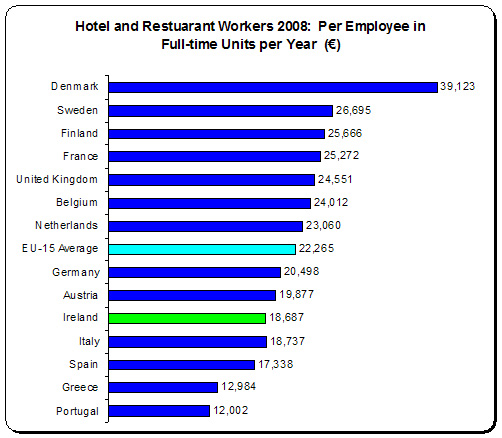
Hospitality Workers

NOTE:  Belgium data extrapolated from general services wages data.

  • Irish wages in the hospitality sector are -16.1 percent below the EU-15 average.
  • They stand 10th in the table, just above the much poorer Italy.

Since 2008 average weekly earnings have fallen by over -7 percent in the hospitality sector. While there is no current data on earnings throughout Europe, in the services sectors as a whole, wages have slightly increased over the last two years. So the gap between Irish wages and the EU-15 average will have widened.

Supporting the hospitality workers is not only about social justice for the workers, it is about supporting growth in the wider economy – increasing domestic demand, increasing business turnover, increasing employment, increasing fiscal stability.

It certainly has nothing – nothing at all – with competitive wage levels.

4 responses to “Support the Hospitality Workers”

  1. Anna Visser Avatar
    Anna Visser

    Michael, from your table it looks like Ireland actually worse than Italy?

    Like

  2. CMK Avatar

    News of this court action depresses me no end. I hope all those commentators who’ve written ‘minimum wage is too damn high!’-type columns over the past few years are happy now. Are the unions going to adopt the usual bunny-caught-in-the-headlights stance and hope the case goes the employers way without too much fuss?
    What isn’t addressed in this article is the question of whether there is a strata of senior members in unions representing the potentially affected worker who fundamentally agree with the national necessity of reducing the minimum wage and getting rid of Joint Labour Committees etc? How many union leaders really believe in the ‘competitiveness’ agenda? It looks like too many do by default as they’re unwilling to mount any kind of effective resistance or even articulate a consistent and forceful social democratic response to the crisis. If these gurriers win, there’ll be a full scale assault on workers’ pay, conditions and living standards across the economy. Sadly, we’ll probably have the Labour party telling workers not too resist or fight back ‘in the national interest’ with union leaders taking the same view.

    Like

  3. Michael Taft Avatar

    NOTE To Readers: the Eurostat data was updated two days after the above was posted. There have been slight revisions upwards to Irish labour cost and wage rates. I haven’t had time to go through all the permutations – but Irish labour costs in the Hospitality sector are 5 percent below the EU-15 average and over 15 percent below the non-Mediterranean average (excluding the poorer Spain, Portugal, Greece and Italy). Apologies for any confusion but I just came across the revision today.
    Anna – Irish hourly labour costs are exatly the same as Italy with the new revisions. This says something as Italy would be a poorer country than Ireland when measuring national income.
    CMK – I believe there is some cause for optimism. The ‘Coalition to Protect the Lowest Paid’ is made up of civil society organisations, including trade unions. The participants include UNITE, SIPTU and Mandate along with the Migrant Rights Centre, The National Women’s Council, Community Platform, The Poor Can’t Pay, etc. They have been active organising petitions, protests, statements, etc. The participation of the unions have been critical as they have day-to-day experience with the JLCs and EROs which are being lined up for the chop.
    My own belief is that the trade union movement will fight this battle – as it affects not only over a quarter of a million workers, but hundreds of thousands more just above the line whose pay is linked to the JLC rates. And I say that acknowledging that the response to pay cuts – in the public sector in particular – by the trade union movement has been less than stellar.

    Like

  4. CMK Avatar

    Michael, thanks for clarifying that. I hope the unions do make a fight of it, but I won’t get too excited just yet. It will be interesting to see if union leaders can withstand the inevitable barrage of hatred from the mainstream media in defence of what should be unquestioned conditions and wage rates (which are themselves inadequate for living in this society even though they are protected).
    These kinds of attacks demand an aggressive response. The unions should be ‘naming-and-shaming’ those responsible. Hopefully the courts will rule in favour of the existing arrangements, but I have a funny feeling they won’t.

    Like

Leave a comment

Navigation

About

Commentary on Irish Political Economy by Michael Taft, researcher for SIPTU