
We are hurtling towards the economic relegation zone – and few are noticing.
Over on Progressive-Economy, Anonymous left a comment on a post I did regarding exports:
‘If what you are saying is that a big part of our economy is detached from the main economy, and that our GDP and even GNP figures are not giving a true steer on our nation's wealth, does that mean that our true 'peer' countries are Italy and Spain rather than the 'core' European nations like the Netherlands and Belgium?’
This is big, big topic – the accuracy of our GDP and GNP numbers; far too big to get into here (but I hope to return to this topic soon). However, let’s take up the question of where we stand in the EU-15 league tables and who is our peer group.
For a range of comparisons (e.g. wages, income, etc.) I have used two types of measurements: EU-15 (or Eurozone) and Peer Group averages where the latter excluded the poorer Mediterranean countries: Spain, Italy, Greece and Portugal. After all, when prior to the recession, the Irish economy was attracting headlines like ‘2nd wealthiest country in Europe’, it made sense to argue that our peer group were the Northern European economies. However, the situation is changing – rapidly.
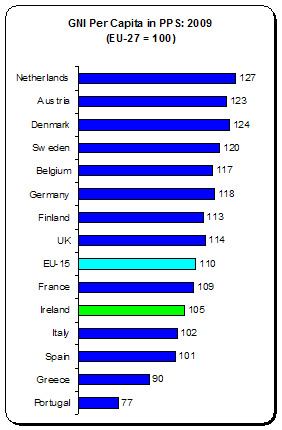 This table is based on a Eurostat measurement of GDP per capita in PPS (Power Purchasing Standards). I have adjusted all countries for Gross National Income, or GNI. GNI is equal to GNP plus income flows from the EU and, so, is the final statement on income in the country. Most commentators assume that GDP and GNP/GNI is the same for all other EU countries, except for Ireland but this is incorrect. For most EU countries, GNP/GNI is, like Ireland, lower than their GDP – though not to the same degree.
As seen, Ireland is in the bottom half of the table, only slightly above Spain and Italy and well behind most other Northern European countries. This is quite a turnaround. Only two years earlier, Ireland’s GNI per capita was tied in 2nd place with Sweden, just behind the Netherlands. But into the second year of our recession, Ireland has been in free-fall.
Back in the 1980s we were the part of poor Europe – alongside Spain, Greece and Portugal (Italy had yet to meet Silvio Berlesconi and was a relatively high-income economy; it has been sliding for a number of years).
However, with the coming of foreign direct investment in the 1990s, Ireland motored up the table. We put considerable space between ourselves and the other peripheral countries and were just under the EU-15 average. For instance, in 2000 Ireland came in at 112 while Spain was mired down in 95 – a gap of 17. Now the gap is 4.
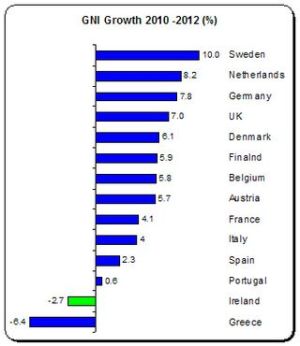 What can we expect in the future? Not much. The EU Commission suggests we will continue to slide. Over the three years 2010-2012, the EU projects Swedish GNI to grow by 10 percent, followed by the Netherlands and Germany.
Ireland, however, will continue to fall behind – not only Northern European countries but the EU-15 average. Over the full three years we will be in negative territory; only Greece will perform worse (notice how it is the two bail-out, uber-austerity countries that are plummeting?).
By 2012, the EU projects Irish GNI will return to growth – but just barely: 0.3 percent. By that time, the EU-15 average growth is estimated to be 1.8 percent.
Though it’s hard to predict, it is quite likely that on the basis of EU projections, Ireland will fall behind Italy and Spain in terms of GNI per capita in PPS. Our peer group in the future will not be other Northern European countries – but in truth, they never were. It was all a fantasy – fed by asset-bubbles, cheap money, speculation and an ideology that stated ‘if the market does it, it must be right.’
How wrong all that was. And with more years of austerity ahead of us – we will wake from our fantasy only to walk into a nightmare.
 Notes on the Front
Leave a comment