
 One can only chuckle. Last year the pronouncements of rating agencies were treated as though they were written on Mount Sinai. Downgrades, or the threat of such, were interpreted by our high priests of deflation as demands to cut public spending. That’s what we did – big time; slashing public spending by nearly €9 billion in one year (nearly two-thirds more than the McCarthy committee recommended). Surely our sacrifices would please the gods.
Now the high priests are confused. Our bond performance kept weakening and the downgrades have kept coming, even after all our fiscal sheep and goats were sacrificed (and earnest assurances that our bank bail-outs are affordable and manageable). So, instead of questioning whether they got the translation wrong, the high priests have turned on the gods themselves. The economy hath no fury like a deflationist scorned. Some of us, however, never treated the rating agencies as anything other than culprits in the international financial crisis.
But that doesn’t mean we shouldn’t be worried. Maybe the ‘international markets’ know something that is not being reported here. Take the recent projection of the ESRI.
According to the ESRI, if the Government persists with its present strategy our debt as a percentage of GDP will be 106.9 percent by 2020 and rising. With regards to GNP, it will be 134.1 percent and rising. No wonder the Government’s policies are getting hammered.
What has been the response? What little there has been shows that old habits die hard. It was suggested that the Government should, maybe, considering cutting €4 billion out of the next budget, not €3 billion as they have announced. Shovel. Hole. Dig.
What effect would this have? Hardly any. Using the ESRI’s real growth projections (and taking the consumer price estimates as a proxy for the deflator) I calculate the following.
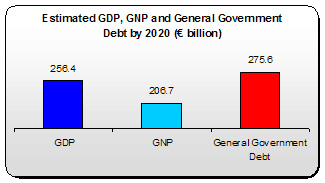 Our general government debt will be approximately €275 billion by 2020. Is anyone really suggesting that cutting an extra billion in 2011 is going to have any impact whatsoever? Even on a static basis, it would only reduce the debt by a couple of percentage points. Actually, it would be less because the impact of the cut would be to slightly reduce economic growth, slightly reduce tax revenues, and slightly increase unemployment costs. Overall, the impact would be a fraction.
Cut €2 billion more? Cut €3 billion more? Twice, thrice a fraction still remains a fraction.
We are at the end of the road but the deflationary wagon train still keeps going forward. It’s heading towards the abyss. And the problem is that we can’t jump off. Unless we stop the train – and stop it now – we’ll be heading over the edge with it.
And no doubt the high priests of deflation will then find a new scapegoat. I nominate the decadent effect of raspberry vinaigrette on modern fusion cooking. For the purposes of avoiding the truth, it works as good as any.


 Notes on the Front
Leave a comment