
 Oh, that speech. One might think the Taoiseach had a Damascus Road conversion – and in front of the Dublin Chamber of Commerce in the Four Seasons Hotel of all places. That somehow he looked deep into his soul while he was looking ‘everyone in the eye’ – and came forth with new economic tablets to present to the wandering idolaters of a broken god:
‘And, verily I say unto you, I have seen the promised land, and to get there we must socialise and democratise our ways, we must, through the state, mobilise an entire people’s capital, resources, skill and imagination. For I shall bring down the rich and raise up the poor . . .’
Seriously, though, what made this speech so notable? The Irish Times tells us:
'Mr Cowen had nothing particularly newsworthy to say to the Dublin Chamber of Commerce . . . He made his best speech since he entered office . . . ‘
Whaaa? What we are told is that it was a ‘passionate’ speech, ‘from the heart’, delivered without script or notes. Okay, some finger pointing and pounding of the lectern. But the Irish Times goes further:
‘ . . . he gave a sense that he was on top of the problems facing this country.’
A sense? Maybe I’m mistaken but wasn’t Brian Finance Minister for nearly four years before becoming Taoiseach? Hasn’t he been in Cabinet for something like fifteen years, serving in six portfolios? At the very least we would expect him to be ‘on top’ of things, even if we disagree with his policies. But so fearful is the nation that things are getting out of control, that a speech in which the Taoiseach merely gives a ‘sense’ that he’s grasped the issues becomes a source of relief.
It is difficult to critique the speech from a programmatic perspective for the simple reason Cowen’s emphasis was not policy. Rather, he stressed themes of ‘solidarity’ and ‘together’ (he used these words thirteen times). This had particular urgency after the collapse of the social partnership talks. Cowen defended the process and managed to take some solace:
'. . whilst we didn’t come to full agreement on every detail, there was, and is, an understanding of the scale of the problem. . that our public finances must be brought under control. There was an agreement that as an initial step . . a €2 billion adjustment was needed. And whilst we didn’t agree the detail, I think it was time well spent.' (translation: adjustment = cuts).
Well he might think it time well spent. Because for all the ‘we’re-in-this-together’ chum-talk, Fianna Fail ruthlessly and cynically exploited the talks for its own agenda, making demands on one partner and one partner only, backing them into a corner before dumping them on the cold streets outside Government buildings before dawn. When I read Brian’s ‘I like talking to people, working with people’, I gagged.
Admittedly, ICTU opened the door. It was an understandable mistake to have agreed the following clause in the Strategic Framework:
'The Government and Social Partners agree that a credible response to the fiscal situation requires a further adjustment at this stage of the order of €2 billion in 2009. In addition to this immediate adjustment . . . the Government and Social Partners commit to working together under the Pact to support the further adjustments required to reduce the General Government Deficit below 3% over the remainder of the five year period.'
Understandable, insofar as the €2 billion figure was a given (but why agree it, why agree a medium-term deflationary policy, negotiate the immediate issues and let Government stand over its' own right-wing policies). ICTU hoped they could negotiate a more equitable way of doing this – primarily through tax increases. This proved optimistic: the Government made it clear that tax increases were off the agenda for 2009 as Minister Lenihan had unequivocally ruled out a mini-budget. ICTU, therefore, was trapped.
This became apparent when the Government kept coming back to the trade unions during the talks with, ‘You accepted €2 billion in cuts, what are you suggesting?’ Notice how the reduction of the deficit was transformed into cuts? Fianna Fail could do this because they controlled the language and the ideological-thrust of the talks. And so bullish were they, the refused movement on other important issues (e.g. occupational pension fund protection) to allow ICTU some ‘cover’.
The coup-de-grace came when, only hours before the decisive cabinet meeting, the Government came forward with its pension levy. Now, I’m not a conspiracy theorist; the world doesn’t work because powerful agents control all actions and reactions. However, the very raison d’être of the talks, from the Government’s point of view – (cut the public sector payroll) was not revealed until the end of the process when there was no chance for ICTU to negotiate, barter, trade-off or even prepare the ground. In effect, Fianna Fail slapped down the pension levy and showed the trade unions the door.
This suited the Government for now they had the best of both worlds: if ICTU bought into it then Fianna Fail pulls off a major political coup: consensus over difficult issues. But: if ICTU walked out, Fianna Fail could launch a new political narrative. And launch they did.
How, freed from the shackles of social partners (read: trade unions; read: public sector trade unions; never read: the business sector), Brian Cowen can now become the leader he was destined to be. Cue: the Four Seasons Hotel.
And how fitting Brian chose the Chambers of Commerce for his make-over. For there was nothing the Government did not give to IBEC during the talks. The initiatives will be rolled out in the coming weeks. What ‘sacrifice’ was business asked to make? What ‘burden’ were they asked to ‘share’? No matter how responsible ICTU acted (a Solidarity Pact, an acceptance of cuts), the employers’ contribution to the debate was an insult, nakedly instrumental in pursuit of its sectional goals (firing 70,000 people, destroying pensions, cutting every expenditure except business subsidies).
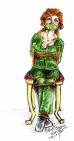
If you want a metaphorical image of the talks, contemplate this: the Government talking with IBEC? Lounging in the Jacuzzi. The Government talking at ICTU? A victim tied to a chair in a dark basement, harangued and shoeless.
So pardon me for gagging when I hear the accolades being poured on a clichéd, cynical and manipulative speech. I fully accept Fianna Fail has potentially pulled off a marvellous coup.
Just don’t expect me to applaud.

 Notes on the Front
Leave a comment