
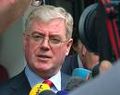
 It would be hard to disagree with the following:
'In truth, Gilmore's speech was a master class; the best that he has ever given and, probably, one of the finest orations given by any political leader at a party conference of any hue in Ireland for many a long year.'
Speaking with confidence and passion, Eamon Gilmore has certainly given his party a badly needed boost – politically and psychologically. And it was his analysis of the economy that contained some of the most far-reaching proposals made by a senior Labour politician. For he sketched out the outlines of a new economic stimulus plan. Stating that neither Fianna Fail nor Fine Gael had the answers, he stated:
'In the short-term borrowing will have to rise, but our national debt is low and can take the strain. That's what the OECD recommended last Monday. But borrowing must be prudent. Used only for investment that demonstrates real return in the future. And Government should set a borrowing ceiling – a limit that must not be crossed. The National Pension Reserve Fund contains over €18 billion. A full seven years ago, Labour argued that part of this money would be better put to work investing in our own infrastructure, rather than playing the market abroad.'
And what would this extra money be spent on? Renewable technology, green collar jobs, urban regeneration projects, hospitals, schools, community and sports centres; Gilmore even called for buying back Eircom so that we can get a proper broadband network up and running. Jobs can be created, services expanded, and living standards raised – at least in the medium-term.
Of course, there is more to an economic recovery package than this: there is a need to critique an economy that is addicted to foreign capital, starved of a strong indigenous base, lacking in modern business practices and managerial expertise, bereft of public institutions that can make investment and productivity cohere. But this is is a starting point where all progressives can rally together and, just as importantly, put a clear distance between the Left and the right-wing parties.
There are two obstacles, however, that must be overcome to ensure that Labour doesn't get stuck at this starting point. First, it is clear that Gilmore's analysis still needs considerable fleshing out. While strong on direction, it is considerably weak on details; nowhere was this shown up more than in the interviews and statements made following the speech.
There was no sense of how big this package might or might not be. The Irish Times claimed it would cost €1 billion. Gilmore, in an interview with Sean O'Rourke, suggested it could be €2 billion because that is what the EU Commission is seeking (a 1%-of-GDP stimulus). Regardless of these figures, a stimulus package will have to be much more if it is to address decades of under-investment in our physical and social infrastructure, while at the same time combating recession.
In interviews with journalists, a series of numbers were put out: doubling the national debt over the next four years, allowing borrowing to increase to 60% of GDP, etc. Considerable work will have to be done to present a more consistent line on the scale envisaged (e.g. a doubling of the debt or allowing it to rise to 60% of the GNP suggests a level of borrowing to facilitate a €25 to €30 billion package – not the €1 or €2 billion tentatively put forward by Labour spokespersons). This is not just a mathematical 'dotting the I's' exercise. The Right and powerful vested interests are waiting to jump on any programme, no matter how mild or moderate, that challenges their obsession with fiscal deficits. If Labour is not prepared when it enters the public debate, its programme will be torn apart.
Further, Labour will have to escape the limitations of 'no borrowing for current expenditure purposes'. On This Week in Politics Gilmore stated:
'I don't think we should be borrowing to fund day-to-day spending. I think you borrow for capital purposes, for your investment in your future, investment in people, investment in education, that's the area where you should borrow.'
Unfortunately, there is no way out of borrowing for current expenditure for years to come. Fianna Fail projects they willl balance the current budget by 2011. And I believe the World Cup willl be brought forward to that year and Ireland willl defeat Brazil in the final. My belief is more grounded (I will discuss Fianna Fail's cooked books and Brazil's weak backline in a later post). To argue that we must balance the current deficit in the short-term (three years) is to risk untold damage on the economic and social fabric, for it will entail considerable public cutbacks or general tax increases or both, lengthening and deepening the recession.
In the context of an expansionary programe, rescuing people from the dole by providing work on infrastructural projects will help the current budget. But remember this: much of capital expenditure results in increased current expenditure. If you build schools (Gilmore suggested four hundred new-builds) you will need teachers, capitation grants, etc. – all increasing current expenditure.
It would be unfortunate if Labour, having escaped the right-wing fiscal trap of either spending cuts or general tax increases by calling for a programe of increased borrowing, fell right back into that trap by agreeing that we shouldn't borrow for day-to-day spending. The urgent issue is not balancing the books – current or capital – but rather getting the economy up and running. The current budget can be addressed on the other side of the recession and its aftermath- a process that will run for years.
The second obstacle Labour must overcome is to develop a political strategy to implement its economic programme. Whether Labour likes it or not, they will continue to be harassed by the media and by a whole lot of interested voters: will you rule out serving in a Fianna Fail Government (Ursula Halligan was so obsessed by this issue that she didn't even cop the muchmore important news that Labour was rejecting the fiscal conservative consensus). Clearly, Gilmore was uncomfortable on this subject, distancing himself from Jack O'Connor's Fianna Fail-frying pan-Fine Gael-fire analogy. He elaborated to Sean O'Rourke:
'I don't have any personal ambitions (to be Taoiseach) . . . We've always had the ambition that Labour should aspire to lead a government. Whether that happens in the period of time that I'm a leader remains to be seen. I think there there are a lot of people who don't define themselves in terms of Fianna Fail or Fine Gael and want an alternative to that . . Jack O'Connor was expressing his own view. I've worked with Fine Gael in opposition, we cooperate on a number of issues. If you look at the last opinion poll the most likely outcome would be a Labour Fine Gael Government . . . I would prefer to see a change of government.'
If a political strategy is to be divined from this, it's that the election result will determine the composition of the government. For Labour, this is a dangerous route. If it doesn't declare against Fianna Fail then those who want a change of government may be worried that they won't get it if they vote Labour. But declaring against Fianna Fail would undermine Labour's 'independence'; it would be a return to the 1980s formulation when Labour ran on an 'independent platform' but everyone knew it would support Fine Gael if the numbers fell right. Furthermore, it would reinforce the fiction that Fine Gael constitutes a political alternative and that Labour only has a support role (it took Senator Alex White to point out that the most logical coalition partners would be the two right-wing partners).
But, more importantly, it would strand their emerging economic programme. For how in the world would Fine Gael coalesce with a party that calls for spending and borrowing their way out of a recession? In fact, if any party would buy some way into that would be Fianna Fail. This is a fundamental problem that will not go away.
Without a political strategy how can you implement your economic policy? And what's the point of a political strategy without a policy to implement? They are two sides of the same coin.
But one obstacle at a time. For now, Labour must concentrate on getting to grip with the principles laid down by its party leader – to create an exciting stimulus package that can capture the imagination of voters. In doing that, they may in time find themselves so distanced from the right-wing parties that coalescing with them as a minority partner is not an option. And when that comes, Labour can sit down and devise itself a political strategy that will see it real win power – the power to implement its programme.
Eamon Gilmore, in one of the most provocative and welcome speeches made by a Labour leader in a long time, has launched the party on a new direction. Where it ends up is anyone's guess, but let's hope it's an exciting and progressive place.


 Notes on the Front
Leave a comment