Notes on the Front

Commentary on Irish Political Economy by Michael Taft, researcher for SIPTU

October 20th Lunchtime: The Recession Diaries

They say a picture is worth a thousand words.  I think that's an underestimate.
SBPost - O'Brien

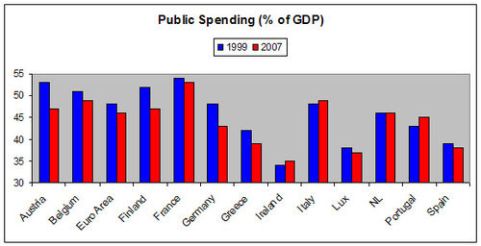
The chart above is taken from an analysis by Dan O'Brien of the Economist Intelligence Unit which appeared in yesterday's Sunday Business Post.  He presented this chart to make a point: 

'The increase in public spending in Ireland over the past decade has been far larger than in any of the other 11 long-standing members of the eurozone. No one doubts that much of it is wasteful. Chart 2 (above) illustrates the folly of the government’s approach. Only three eurozone countries have seen spending rise as a percentage of GDP over the past decade. Apart from Ireland, these countries are Italy and Portugal.'

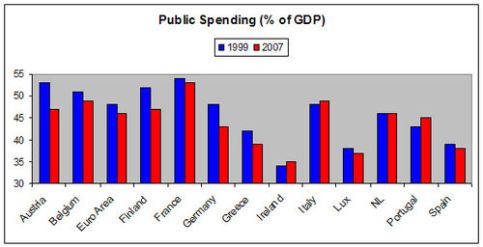
It's an interesting point.  But are we in danger of missing a bigger point?  Are we stepping into elephants-mice-and-room territory?  Let's look at it again.
SBPost - O'Brien

Fine Gael insists that the root cause of all our economic woes is 'profligate' public spending: 

'The real tragedy is all these measures would have been unnecessary if the Government had taken the brave decisions needed to control day-to-day public spending . . . "It is this increase in day-to-day spending by an unreformed public sector that is driving up our borrowing next year.'

Oddly, this is the same line the Government is taking (though obviously they're putting a different spin on it): to get out of the recession we must cut government spending, we must get public spending 'under control', we must reign our proclivity to 'live beyond our means'.  This line, in one form or another, is supported by IBEC, ISME, SFA, Chambers of Commerce Ireland, most media commentators, Independent House, Irish Times' leader writers, the Business Post – you name them, they want to cut it.

I have a slight problem with all this.  Is it really plausible that the cause of our fiscal meltdown and recessionary decline can be put down to 'uncontrollable spending' when

  1. Ireland spends less (and I mean really less) than any other Euozone country

  2. That Ireland's increase in expenditure amounted to 1 bloody percent of our GDP – at a time when our population was growing much faster than almost any other country EU country?

Could it be that our ability to cope with the meltdown is encumbered, not because our spending is too high, but rather because our spending is too low?   Is it possible that we do not have the resources to engage in 'counter-cyclical' policies (that is, flood money into the economy to maintain activity) because of our low-tax, low-spend economy?  Other countries which much, much higher spending are going through hard times, yes – we're all living together in this global downturn; but these 'profligate' countries haven't seen their economic fall like a parachutist without a parachute.

If someone were to come along and argue that, given the distorted nature of our economic base (over-reliance on FDI, the poor state of our indigenous base, a distorted export platform, etc.), our spending cannot be sustained – well, at least that would show an appreciation of some of our real problems. Or that our tax levels have been so historically low that we do not have the slack to combat recessionary pressures now. At least with a high-tax economy you can cut taxes temporarily to get money into people's pockets and cash-flow into business's accounts.  But if we tried that, we'd have to cut already starved public services and drive up borrowing more.

But the Right won't argue any of that that because it would call into question the very basis of economicic policies that all parties have supported, policies whose shortcomings all parties have ignored.  It would call into question the very nature of the Celtic Tiger economy; the low-tax, low-spend, low-service economyy we have all accommodated ourselves to; a model of social partnership which is based on tax cuts and counter-productive spending limits.  At the best of times, people find such questions awkward.  In the worst of times we're all too busy taking cover.

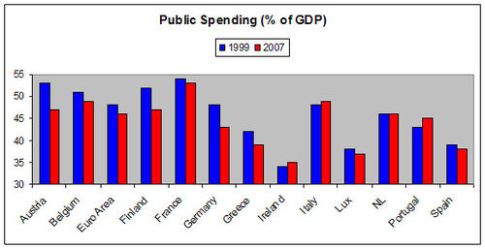
So better to shout about the mouse running about the room, even when the elephant is trampling us into the floor.  Better to ignore what this picture is saying.
SBPost - O'Brien 

4 responses to “October 20th Lunchtime: The Recession Diaries”

  1. Niall Avatar

    Michael,
    The real table is the tax take. Ireland has the lowest tax take in the EU, with Romania. Do we want Romanian levels of Public Services?

    Like

  2. Tomaltach Avatar

    Michael,I saw that piece and I couldn’t believe that he didn’t at least parry the obvious with a ‘while our overall percentage is low in european terms’.
    I would agree with your theory that a big problem is that we have pared at away at our tax base so that there is nothing now to cut in order to stimulate. we are left with little choice but to cut spending and increase tax in the face of recession (in order to stabilise the current spending). But obviously cutting spending now and raising taxes is pro-cyclical and will accelerate the slump.
    There is one issue though with the public service and speding. While I reject the overall ‘bloated’ nonsense it seems to me that during a boom when gov coffers will quite full, we spawned agencies to take on hundreds of new roles. Some of these were essential, but are all of them economic or social value for money? And in a boom when spending is not controlled terribly well isn’t it in the nature of organisations to get fat – managers want to take on more, and run pet projects and argue for extra funding which isn’t that well vetted etc. This happens in the private sector and then there are periodic culls. Surely it happens in state organisations and agencies too. (I’m not confusing his for arguing that we need a smaller state overall – I argue for more comprehensive health provision etc, but what I mean here is that some state agencies must have accumulated waste)
    Finally in terms of sharing the pain, if more tax is needed, I have been pondering how to get it. One thought was to have a rapidly progressive bands above 100k. The question is, would that end up curtailing more consumer spending or result in income being delivered through more evasive measures? I wonder are there models to test this?

    Like

  3. Michael Taft Avatar

    Niall, I would have thought that the question is, not whether we want Romanian level of public services, but whether we’re going to get it whether we like it or not. Certainly the Government is dragging us down to that level – first, cutting taxes and, now, cut spend. Maybe we need to get our older citizens mobilised on other aspects of public services. They certainly have the power.
    Tomaltach, on the issues of public agencies, you’re right. We shouldn’t get hung up on the principle of merging or even abolishing agencies. Every once in a while it is important to review agencies, etc. to see if, in changed times, they too shouldn’t be changed. Of course, the Government is abusing this principle (abolishing the independence of the Combat Poverty Agency is one such abuse). However, I doubt there is much in the way of savings. When Fine Gael proposed their own ‘culling’ of public agencies, they stated it would save €250 million over 5 yars – or €50 million. Not a whole lot, especially when one factors in the usual ‘opposition exageration’. Still, it should happen regardless – for the sake of efficiency.
    I have always argued that the Left should be hard on public expenditure. If you’re going to go to the public and argue for more expenditure, people have to be confident that their extra tax money is being well spent. One sexy proposal would be a radical extension of the Comptroller and Auditor General’s office – to the point that it has sub-offices in each ministerial department and major public agency, each report annually or even half-yearly. That’s an investment which could see a valuable return.
    On the wider issue of the pro-cyclical nature of raising taxes/cutting expenditure – I wouldn’t be so pessimistic to say that we have little choice. I accept, though, that our room for manuevre is limited. However, I think this is an extremely important are for Left and trade union researchers and commentators should be focussing on. Even the ESRI accepted that, in addressing the fiscal meltdown, we would in all liklihood, extend and deepen the recession. I will put my mind to this issue in the near future – but it is difficult.
    On the issue of higher taxes on the wealthy – I support that rain or shine. However, we should be aware of the effects. First, there is not a pot of gold in imposing a top rate of tax on, say, income over €100,000. A 5% tax rate would gain us between €250 – €300 million. Nothing to sneeze at but hardly a pot of gold. As to whether it would reduce demand, there are economists who would argue that taxing high incomes would not reduce demand but would probably reduce savings. It’s when you tax low and middle incomes – like the 1% levy – that’s where demand gets hit. Again, I’ll try to come back on this when considering how we can solve the fiscal crisis without reducing demand in the economy? Please, don’t lay odds – unless their very very long.

    Like

Leave a comment

Navigation

About

Commentary on Irish Political Economy by Michael Taft, researcher for SIPTU